














TL;DR:
- Precise knowledge of vintage guitar terminology helps avoid costly misinterpretations and overpaying.
- Understanding pickup types, like PAF and P-90, is essential for evaluating tone and value.
- Body construction features such as center blocks, laminated, and carved tops significantly impact sound and durability.
Walk into any guitar shop or vintage instrument auction and you will hear terms thrown around with total confidence: PAF, center block, carved top, dog-ear, laminated maple. But here is the uncomfortable truth: even experienced collectors sometimes misuse these words, and that confusion can cost serious money. A guitar listed with “PAF-style” pickups is not the same as one fitted with genuine PAF pickups), and the difference in value can be thousands of dollars. This guide cuts through the noise, defines the terms that matter most, and gives you a framework to buy, sell, and evaluate vintage guitars with genuine precision.
Table of Contents
- The anatomy of vintage guitar terms: Why language matters
- Pickups decoded: PAF and P-90 explained
- Body construction terms: Center block, laminated, and carved tops
- Practical glossary: Quick-reference vintage guitar terms
- Why vocabulary is your most powerful tool as a vintage guitar collector
- Take your vintage guitar knowledge to the next level
- Frequently asked questions
Key Takeaways
| Point | Details |
|---|---|
| Know key vintage terms | Familiarity with terms like PAF, center block, and carved top is essential for collecting and valuing vintage guitars. |
| Terminology affects value | Accurate knowledge of terminology can impact price, authenticity, and your investment success. |
| Sound shaped by design | Body construction and pickup types directly influence tone and playability in vintage guitars. |
| Glossary as collector’s tool | Keeping a handy reference of terms aids decision-making and sharpens your expertise in the vintage market. |
The anatomy of vintage guitar terms: Why language matters
The vocabulary of vintage guitars did not appear overnight. Most of it grew organically from factory floor decisions, patent applications, and marketing choices made by instrument makers in the mid-20th century. Gibson, Fender, Gretsch, and others coined terms for specific innovations, and those terms stuck, even when the things they described changed over time. Understanding the evolution of guitar terms helps you see that language here is not just shorthand but is often a legal and historical record.
Why does this matter to you as a collector? Because imprecise language is where deals go wrong. A seller who describes a guitar as having a “carved top” when it actually has a pressed laminate top is either uninformed or misleading you. Either way, you pay a price if you do not know the difference. Consider these situations where terminology gaps can lead to real problems:
- Buying a guitar advertised as having “original PAF pickups” when the seller actually means replica or PAF-style units
- Overlooking a legitimately valuable instrument because its listing used unfamiliar technical terms
- Overestimating value on a “semi-hollow” guitar that lacks a center block and therefore behaves sonically like a full hollowbody
- Misidentifying a P-90 pickup as a humbucker based on cover shape alone
“The collector who can read a specification sheet like a fluent speaker finds gems where others see confusion.”
The history of electric guitar terms reveals that manufacturers sometimes used the same word to mean different things across production eras. Gibson’s own nomenclature shifted as production methods evolved through the 1950s, 1960s, and beyond. Knowing the specific year and production context of a term is often just as important as knowing the term itself.
Pickups decoded: PAF and P-90 explained
Vintage pickup terminology is where collectors either gain a massive edge or make their most expensive mistakes. Two terms dominate the conversation: PAF and P-90. Both refer to specific Gibson pickup designs, but they are built differently, sound different, and carry very different collector profiles.
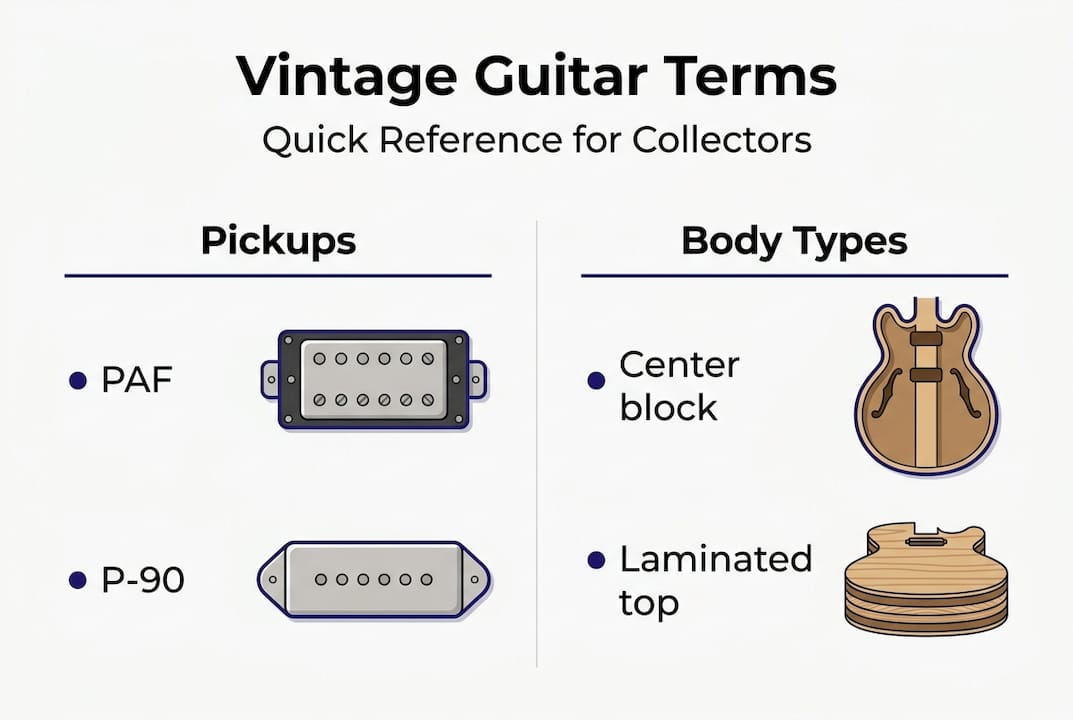
The PAF pickup is arguably the most discussed component in all of vintage guitar collecting. PAF refers to Gibson’s early humbucker) pickups, and the name comes from the “Patent Applied For” sticker placed on the underside of the pickup baseplate between approximately late 1956 and late 1962. These are hum-canceling pickups, meaning they use two coils wound in opposite directions to eliminate the 60-cycle hum that plagued single-coil designs. What makes genuine PAF pickups so fascinating to collectors is their inconsistency. Gibson wound them by hand, and the number of winds varied from unit to unit. DC resistance readings can range anywhere from around 7.5kΩ to nearly 9kΩ. This variation is not a flaw. It is precisely why PAF-equipped guitars from this era each have their own tonal character.
The P-90, on the other hand, is a single-coil design that predates the humbucker and remained in production across different models. P-90 pickups on classic Gibson models like the ES-125 feature Alnico V magnets and typically read between 7.5 and 8.5kΩ, delivering a tone characterized by warm midrange and a bright, snappy attack. P-90s come in two physical housings: the soapbar (a rectangular cover with no mounting ears) and the dog-ear (a cover with protruding mounting tabs on both sides). The housing affects installation but not tone.
Here is a comparison of the two pickup types to make the differences concrete:
| Feature | PAF humbucker | P-90 single-coil |
|---|---|---|
| Coil type | Dual coil (hum-canceling) | Single coil |
| Magnet | Alnico II or V (varied) | Alnico V |
| Typical DC resistance | 7.5 to 9.0kΩ | 7.5 to 8.5kΩ |
| Hum sensitivity | Low (hum-canceled) | High (hum-prone) |
| Tone character | Warm, full, balanced | Bright, clear, midrange-rich |
| Collector period | 1956 to 1962 (original PAF) | 1946 onward |
| Cover variations | Nickel or gold, no poles | Soapbar or dog-ear |
The tonal contrast between these two pickups is dramatic enough that many players describe it as choosing between two entirely different guitars. PAFs tend to round off high-frequency harshness, giving leads a creamy quality. P-90s bite into your playing with more presence and edge. Understanding these distinctions is essential whether you are evaluating an ES-335 for a collection or considering restoring vintage pickups on a guitar you already own.
Pro Tip: When verifying a PAF pickup, ask the seller for DC resistance readings from both coils individually. Genuine PAFs often show slightly mismatched readings between coils due to hand-winding variation. Perfectly matched readings may suggest a modern reproduction.
Body construction terms: Center block, laminated, and carved tops
The physical construction of a guitar body shapes not just its sound but its durability, its susceptibility to feedback, and ultimately its value in the collector market. Three terms come up constantly: center block, laminated top, and carved top. Getting these right is non-negotiable for serious collectors.
The center block is a solid piece of wood, typically maple, running down the center of a semi-hollow guitar body between the neck joint and the tail. A solid maple center block in semi-hollow bodies like the ES-335 serves two purposes. First, it adds sustain by giving the strings a solid anchoring point for vibration transfer. Second, it dramatically reduces feedback at high volumes, which is why semi-hollow guitars became popular on loud stages. Without a center block, you have a fully hollow body, which resonates beautifully in acoustic contexts but can howl uncontrollably through a cranked amplifier.

Laminated tops are made from multiple thin layers of wood pressed and glued together. The exterior layer typically has visible wood grain, which can make a laminated top look much like a solid wood top at a glance. Laminated maple tops resist feedback and are structurally more stable in changing humidity and temperature conditions. However, they transmit vibrations less efficiently than solid wood, which slightly reduces acoustic resonance. That is an acceptable trade-off in a semi-hollow electric guitar designed primarily for amplified performance.
Carved tops represent the higher-construction tier. These tops are shaped from a solid piece of wood, typically spruce or maple, using hand carving or precision machinery. The arched profile is not stamped into shape. It is carved, which maintains the structural integrity of the wood grain throughout the top. This approach contributes to why old guitars sound better: the solid wood vibrates more freely and develops richer overtones over decades of use. The trade-off is that carved tops are more susceptible to cracking under humidity stress and require more careful long-term maintenance.
Understanding guitar wood differences between laminated and carved construction is essential when assessing any archtop or semi-hollow guitar. For a deeper look at how construction wood affects tone and investment potential, the role of tonewood in shaping vintage sound is worth studying alongside hardware considerations like the bridge type comparison between vintage tremolo and fixed-bridge designs.
Here is a quick-reference comparison of body construction types:
| Construction type | Material | Feedback resistance | Resonance | Durability |
|---|---|---|---|---|
| Center block semi-hollow | Laminate plus maple block | High | Moderate | High |
| Full hollow, laminated | Pressed laminate | Low | Moderate | High |
| Full hollow, carved top | Solid spruce or maple | Very low | High | Lower |
| Solid body | Solid mahogany or ash | Very high | Lowest | Highest |
When evaluating a guitar for purchase, follow this sequence to correctly identify body construction:
- Ask for the internal construction details or factory spec, especially on semi-hollow models
- Look inside the f-holes with a flashlight to check for a visible center block running the length of the body
- Tap the top gently near the bridge and listen. A hollow tap indicates laminate. A slightly denser resonance may suggest solid wood
- Check weight. A typical ES-335 weighs 7.5 to 9.5 lbs with a laminated maple top, back, and sides combined with its center block
- Cross-reference the model number and production year against known factory specifications
Pro Tip: Never rely solely on visual inspection to distinguish laminated from carved tops. Look at the wood at the binding edge. On a laminated top, you can sometimes see the layered construction where the binding meets the top wood, especially under magnification.
Practical glossary: Quick-reference vintage guitar terms
With the main terminology explored in detail, here is a quick-access glossary summing up the essential words every collector should know.
- PAF: Patent Applied For. Gibson’s original humbucker pickups produced from approximately late 1956 to late 1962. Hand-wound, hum-canceling, and variable in resistance and tone. Highly collectible and often the most significant value driver on a vintage Gibson.
- P-90: Gibson’s single-coil pickup design introduced in 1946. Characterized by warm mids and bright attack. Available in two cover styles: soapbar (no mounting tabs) and dog-ear (with mounting tabs). More susceptible to 60-cycle hum than humbuckers.
- Soapbar: The rectangular P-90 cover style without protruding mounting ears. Common on Les Paul Standard and ES-5 models.
- Dog-ear: The P-90 cover style with angled mounting tabs on both sides. Common on ES-125 and similar thinline models. The name comes from the shape of the tabs, which resemble a dog’s folded ears.
- Center block: A solid maple block running through the interior of a semi-hollow guitar, connecting the neck joint to the tail block. Provides sustain and reduces feedback. Characteristic of guitars like the Gibson ES-335.
- Laminated top: A guitar top constructed from multiple layers of wood pressed together. More stable and feedback-resistant than solid wood but acoustically less resonant. Standard on many vintage semi-hollow and archtop electrics.
- Carved top: A guitar top shaped from a single piece of solid wood through carving. Produces superior acoustic resonance and develops tonal complexity over time. More fragile and humidity-sensitive than laminate construction.
- Semi-hollow: A guitar body style that combines hollow wing chambers with a solid center block. Bridges the gap between solid body sustain and hollow body resonance.
- Archtop: A guitar with a curved, arched top surface as opposed to a flat top. Can be laminated or carved, hollow or semi-hollow. Associated with jazz and electric blues traditions.
These terms form the core vocabulary you need to read listings accurately, ask the right questions at auctions, and communicate with other collectors and dealers without confusion.
Why vocabulary is your most powerful tool as a vintage guitar collector
Here is an opinion that may push back against what you typically hear: most collectors focus their energy on finding the right guitar when they should be focused on building the right vocabulary first.
We have seen buyers walk past extraordinary finds because the listing used technical language they did not fully understand. We have also seen collectors overpay by tens of thousands for instruments described in flattering but imprecise terms. The guitar was not the problem. The language barrier was. When you know exactly what a seller means by every word in a listing, you stop making emotional decisions and start making informed ones.
There is also a subtler advantage. Collectors who speak the language fluently project expertise, and dealers respond differently to that. When you ask precise questions about DC resistance on pickups, construction details, and production year specifications, sellers are more forthcoming with accurate information. They know they cannot oversell to you. That dynamic alone can change the price you pay and the quality of instrument you come home with.
The origins of vintage terms in manufacturing history also give you an interpretive framework. When a term was coined matters because it tells you what production era it belongs to, what it was contrasted against at the time, and why it was considered an innovation worth naming. A collector who understands that context reads a specification not just as a label but as a historical document.
Our honest take: vocabulary is not a shortcut to expertise. It is the foundation. Build it deliberately, question assumptions, and never stop refining your understanding of what these terms actually mean in practice.
Take your vintage guitar knowledge to the next level
You now have a working understanding of the terms that matter most in vintage guitar collecting. But knowing the language is just the starting point.

At Vintage Guitar World, we go beyond terminology to help you find, evaluate, and own instruments with full confidence. Whether you are searching for a PAF-equipped classic, a carved-top archtop, or your first semi-hollow, our curated inventory is backed by expert evaluation and detailed historical documentation. Explore our guide to types of vintage guitars to see how construction and pickup terminology maps directly onto specific models and their collector value. And if you want to understand the deeper passion behind these instruments, our feature on why we love vintage guitars captures what makes these objects so much more than just tools for making music.
Frequently asked questions
What makes PAF pickups so valuable?
PAF pickups from 1956 to 1962) are hand-wound with natural variation in resistance and tone, giving each unit a unique character tied directly to iconic Gibson models from that era, which makes them genuinely irreplaceable collectibles.
How does a center block affect a guitar’s sound?
A solid maple center block adds sustain and reduces feedback, allowing semi-hollow guitars to handle high-volume amplification while retaining some of the warmth and air of a hollow body design.
What is the difference between laminated and carved tops?
Laminated tops use pressed wood layers for stability and feedback resistance, while carved tops are shaped from a single solid piece of wood for superior resonance, though carved tops are more vulnerable to environmental stress over time.
Why do some vintage guitar pickups hum while others don’t?
Single-coil designs like the P-90 pick up electromagnetic interference from nearby electronics, while PAF humbuckers cancel hum) by using two coils wound in opposite directions, which is exactly why Gibson developed the humbucker design in the first place.