












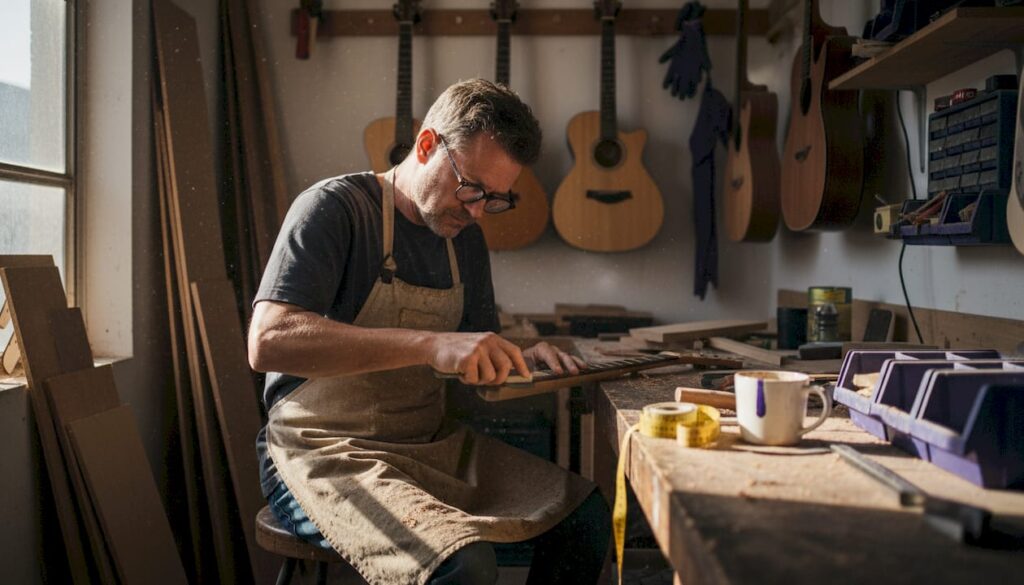

TL;DR:
- Boutique guitar brands focus on personalized construction and builder-to-player relationships.
- They drive innovation influencing mainstream guitar design and manufacturing.
- Boutique guitars are valued as heirloom collectibles with cultural and historical significance.
Most players assume that a higher price tag on a factory guitar means better quality. That assumption costs collectors and serious musicians real opportunities. Boutique guitar brands operate on an entirely different logic, one built around direct relationships between builders and players, obsessive material selection, and a philosophy where every instrument is treated as a singular creation. This guide walks you through what makes boutique brands genuinely different, how they shape the broader guitar market, and why they matter as both musical tools and lasting cultural artifacts worth collecting and preserving.
Table of Contents
- How boutique guitar brands deliver personalized instruments
- Unique craftsmanship and individualized voicing: Boutique’s real differentiators
- How boutique brands influence mainstream guitar design
- Boutique guitars as heirloom artifacts: Appeal to collectors and musicians
- The uncomfortable truth most guitar buyers miss about boutique brands
- Explore unique boutique and vintage guitars
- Frequently asked questions
Key Takeaways
| Point | Details |
|---|---|
| Personalization matters | Boutique guitar brands deliver custom builds and direct communication that factory models can’t match. |
| Craftsmanship is crucial | Each boutique guitar’s sound and feel are carefully voiced and adjusted for the individual player. |
| Market influence | Boutique innovations shape mainstream guitar designs and quality standards. |
| Heirloom value | Boutique guitars are often prized as cultural artifacts and family treasures for collectors. |
| Nuanced decision | Choosing boutique isn’t always about ‘best quality’—fit, voicing, and personal connection matter most. |
How boutique guitar brands deliver personalized instruments
Walk into any major music retailer and you’ll find hundreds of guitars hanging on the wall, each one assembled to meet a standardized specification. The wood grade is consistent. The neck radius is predictable. The finish is identical across an entire product run. That’s not a criticism. It’s simply how volume manufacturing works, and for many players, it’s perfectly adequate.
Boutique brands operate from the opposite direction. Santa Cruz Guitar Company founder Richard Hoover reflects that boutique guitar brands exist to deliver instruments with builder-to-buyer specificity, meaning the guitar you receive is shaped by a direct conversation between you and the person building it. This isn’t just a marketing angle. It changes every decision made during construction.
When you work with a boutique builder, you’re typically specifying things like:
- Body dimensions and depth tailored to your playing posture and comfort
- Neck profile and width matched to your hand size and technique
- Wood species and grade selected for your preferred tonal character
- Nut width and string spacing based on fingerpicking or strumming style
- Bracing patterns adjusted for projection, warmth, or balance
This level of input is simply not possible in a factory environment. Production lines optimize for efficiency. A boutique builder optimizes for you. That’s a fundamental distinction, not a superficial one.
The builder’s identity is also central to the boutique experience. When you buy a guitar from a well-known luthier, you’re buying their accumulated knowledge, their aesthetic sensibility, and their reputation. Learning about famous luthiers gives you a clear picture of how individual vision shapes instruments in ways no committee-driven product team ever could. These builders often work alone or in very small teams, which means continuity of craft throughout the entire construction process.
Pro Tip: When considering a boutique guitar, ask the builder directly about their voicing philosophy. A willingness to discuss tonal goals in specific, technical terms is usually a strong indicator of genuine expertise.
“A great luthier doesn’t just build a guitar. They build a relationship with the player that the instrument carries forward for decades.” This is the essence of what separates boutique building from production manufacturing.
The value of limited-run instruments is also undeniable from a collector’s standpoint. Handcrafted guitar examples show how limited production, combined with distinctive maker identity, creates instruments that hold and often appreciate in value over time. Understanding the role of guitar builders in shaping these instruments helps collectors recognize what they’re actually purchasing when they invest in a boutique piece.
Unique craftsmanship and individualized voicing: Boutique’s real differentiators
Personalization starts with the builder, but what truly sets boutique guitars apart is their craftsmanship and sound design. The concept of voicing is where boutique building gets genuinely technical and where the gap between handmade and factory production becomes most audible.

Voicing refers to the process of adjusting the top (soundboard) of the guitar by carefully removing material in strategic locations to tune its resonant frequency. An experienced luthier taps the top repeatedly during construction, listening for specific pitches and responses, then shaves wood away in fractions of a millimeter until the top behaves exactly as intended. Individualized voicing is a key methodology differentiator in boutique building, something factory production simply cannot replicate at scale because it requires real-time judgment from a skilled craftsperson responding to a specific piece of wood.
No two pieces of wood are identical. Even two boards cut from the same tree will have different stiffness, density, and grain patterns. A factory production line treats wood as a standardized input. A boutique builder treats each piece of wood as a unique variable that requires a unique response.
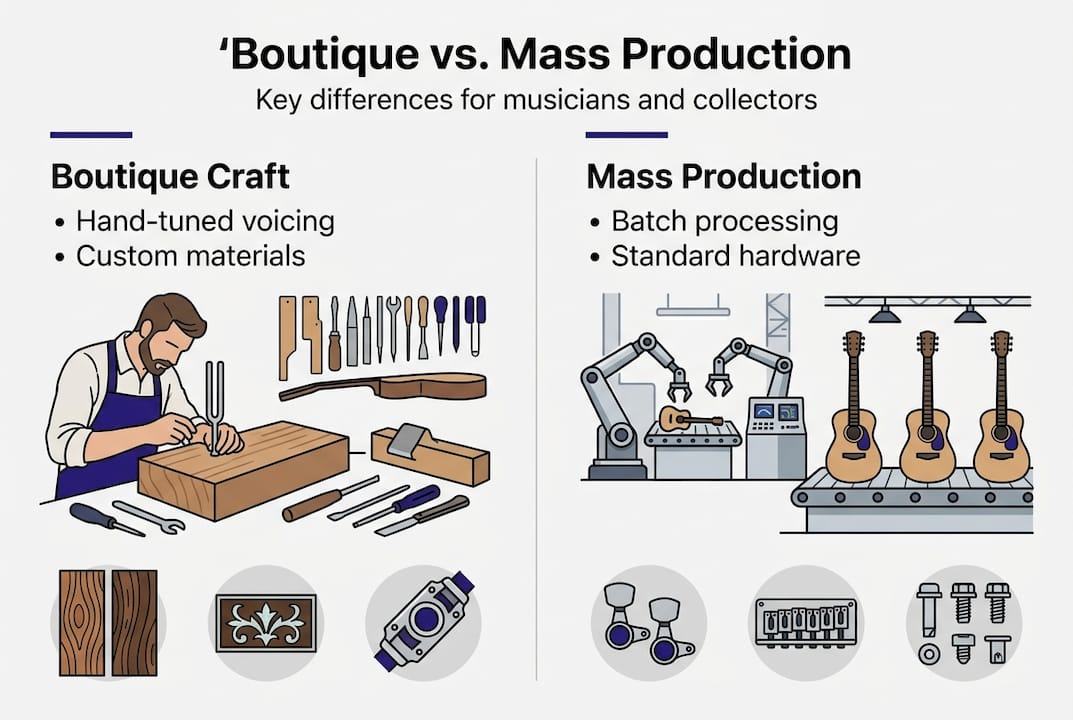
Here’s a quick comparison of what separates boutique craftsmanship from mass production:
| Feature | Boutique build | Mass production |
|---|---|---|
| Top voicing | Individual, hand-tuned | Batch processed, uniform |
| Wood selection | Builder-chosen per instrument | Graded by category, standardized |
| Neck fit | Custom to player specs | Standard profiles across models |
| Finish application | Hand-applied, often thin nitrocellulose | Thick polyester or polyurethane spray |
| Quality checkpoints | Builder at every stage | Multiple inspectors, divided process |
| Build time | Weeks to months per instrument | Hours per instrument |
The handcrafted craftsmanship that defines boutique building also shows up in small but profoundly important details. Fret ends are individually dressed and polished. Binding is cut and fitted by hand. Nut slots are filed to precise depth for each string gauge. These aren’t features you read about in a spec sheet. They’re things you feel immediately when you pick up a well-built boutique instrument for the first time.
Material selection deserves its own mention. Boutique builders often source tonewoods directly from specialty suppliers, estate auctions, or even their own aging stocks of historically significant materials. Old-growth Sitka spruce, Brazilian rosewood (where legally sourced and certified), and figured maple from specific regions all carry tonal properties that simply aren’t available through standard commercial wood channels. This material advantage, combined with luthier expertise, is what produces the tonal complexity and responsiveness that serious players describe as “alive” or “three-dimensional.”
Pro Tip: When evaluating a boutique guitar’s craftsmanship, run your fingertip along the fret ends. A well-dressed fret end is completely smooth with no sharp edges, a detail that takes time but makes the instrument far more comfortable to play.
The artisanal guitar building tradition ensures that every decision, from bracing scallop depth to binding thickness, is made with the player’s sonic goals in mind. That level of intentionality produces instruments that don’t just sound good. They sound right for the person they were built for.
How boutique brands influence mainstream guitar design
The boutique advantage doesn’t just affect individual guitars. It radiates out to the entire market. This is one of the most underappreciated dynamics in the guitar industry, and it’s why boutique brands matter even to players who will never buy one.
When a boutique builder develops a new ergonomic contour, a superior fret wire alloy, or a more efficient bracing system, that innovation eventually finds its way into the broader conversation about what guitars should do. Emerald Guitars demonstrates this principle clearly, with boutique guitar brands shaping the market by influencing engineering and tooling decisions that manufacturers at every price point eventually respond to.
Consider a few specific areas where boutique-driven innovation has moved into the mainstream:
- Compound radius fretboards: Originally a boutique refinement for player comfort, now available on mid-market production models from major manufacturers
- Lightweight tuner hardware: Boutique builders pioneered the use of precision lightweight tuners to improve headstock balance; major brands followed
- Torrefied (thermally aged) wood: A boutique technique for accelerating wood aging; now offered as a premium option by Fender, Gibson, and Martin
- Aged finish aesthetics: Boutique relic work influenced factory-aged finish programs across the industry
A useful way to think about this is through the lens of boutique guitar definitions. When you understand what boutique actually means technically and philosophically, you can trace its fingerprints across the entire guitar market.
Mainstream brands, particularly Fender, have drawn heavily from boutique-inspired details in their Custom Shop and American series instruments. Period-correct wiring, hand-wound pickups, and tremolo bridge specifics that vary between models all reflect attention to boutique-level nuance. These brands are not simply copying boutique builders. They’re responding to a market educated by boutique culture.
| Boutique innovation | Mainstream adoption |
|---|---|
| Compound radius neck | Fender American Ultra, PRS SE |
| Hand-wound pickups | Gibson Custom Shop, Fender Custom Shop |
| Torrefied tops | Martin, Taylor, Fender |
| Lightweight hardware | Grover, Kluson-type on mid-market models |
The cycle matters. Boutique brands experiment at the highest level of craft. Players and reviewers notice the results. Mainstream brands develop production versions. The entire ecosystem moves forward. Without boutique builders pushing the edge, mainstream guitar design would stagnate far more quickly.
Boutique guitars as heirloom artifacts: Appeal to collectors and musicians
The culture around boutique guitars is rich, from market influence to lasting collectibility. What separates a boutique guitar from even a well-made production instrument is the degree to which it carries human identity. A boutique guitar built by a recognized luthier isn’t just a tool. It’s a documented artifact of craft, intention, and often a specific moment in musical culture.
Frank Brothers Guitar Company illustrates this precisely: boutique brands provide a pathway for collectors and musicians to buy instruments as cultural and heirloom artifacts. This framing matters because it shifts how you think about the purchase. You’re not buying a product with a depreciation curve. You’re acquiring a piece of craftsmanship with a legacy.
Here’s what makes boutique guitars so compelling as collectibles:
- Builder provenance: Instruments tied to known luthiers carry documentation of their maker’s methods, materials, and creative philosophy
- Player association: Many boutique guitars are built for specific artists, creating an additional layer of cultural value
- Limited production numbers: Scarcity combined with verified craftsmanship drives long-term value retention
- Material rarity: Tonewoods no longer commercially available, such as pre-ban Brazilian rosewood, make certain instruments irreplaceable
- Condition and originality: Boutique instruments tend to be cared for more attentively, preserving their condition and originality over decades
Understanding guitar heritage helps collectors place these instruments in their proper historical context. A guitar built by a well-known luthier in the 1970s or 1980s isn’t just old. It represents a specific moment in the evolution of American guitar building, a period when many independent builders were pushing back against corporate guitar design and reclaiming the tradition of hand craftsmanship.
“The best boutique guitars aren’t just played. They’re carried forward. One generation’s instrument becomes another generation’s inheritance.”
For those exploring collecting classical guitars, the heirloom dimension is even more pronounced. Classical guitar building has maintained an apprenticeship tradition stretching back centuries, and instruments from recognized makers in the Spanish, German, and French traditions carry extraordinary cultural weight. Collectors pursuing these instruments are participating in a living lineage of craft that connects directly to the origins of the instrument itself.
Why vintage guitars matter as objects of desire comes down to this combination: irreplaceable materials, documented craftsmanship, and human story. A boutique guitar isn’t just something you play. It’s something you steward.
The uncomfortable truth most guitar buyers miss about boutique brands
Here’s where we need to push back against the most common boutique guitar misconception: “handmade” is not the point. Plenty of handmade guitars are mediocre. And some carefully produced factory guitars are genuinely excellent. The obsession with the “handmade” label misses what actually matters.
What separates a truly exceptional boutique guitar is the depth of builder-player dialogue, combined with the luthier’s ability to translate that conversation into tonal and physical outcomes. Richard Hoover’s five decades of work at Santa Cruz Guitar Company demonstrate this clearly. The real differentiator is voicing and fit-to-player work, not simply being handmade. A guitar voiced specifically for a fingerpicker who favors a warm, woody midrange is a fundamentally different instrument than one built to the same specifications but voiced for a flatpicker chasing clarity and volume. The difference lives inside the wood, in decisions made during construction that can’t be undone or replicated.
We’d also be doing you a disservice if we didn’t acknowledge the other side. As research into boutique vs. mass-produced guitars points out, some players genuinely prefer the consistency and reliability that factory production delivers. A session musician who needs to grab any guitar and trust that it will perform within a predictable range may find a boutique instrument’s idiosyncrasies frustrating rather than charming.
The real lesson here is that boutique isn’t inherently superior. It’s specifically suited to players and collectors who value the depth of handcrafted guitar perspective and the personal fit that only direct builder interaction can deliver. Know what you actually want before you invest.
Explore unique boutique and vintage guitars
Ready to discover your own boutique experience or deepen your collecting journey? At Vintage Guitar World, we’ve built a curated space for players and collectors who understand that the right instrument is about far more than a price tag or a brand name.

Our craftsmanship guide covers what to look for in a handmade instrument, from top voicing to wood quality and builder reputation. Explore our breakdown of vintage guitar types to understand which categories offer the best combination of musical value and investment potential. And if you want to see real-world examples of what exceptional luthier work looks like, our handmade guitar examples showcase instruments that represent exactly what boutique craftsmanship can achieve. Every instrument we carry is evaluated, documented, and presented with the detail that serious collectors deserve.
Frequently asked questions
What defines a boutique guitar compared to a mass-produced model?
A boutique guitar is typically built in small numbers by skilled luthiers, offering direct customization and a closer builder-player relationship than mass-produced instruments. As Santa Cruz Guitar Company’s founder notes, boutique brands exist to deliver instruments with builder-to-buyer specificity that factory lines simply cannot replicate.
Why are boutique guitars often considered heirloom pieces?
Boutique guitars are valued as heirloom pieces because they’re built for individuality, crafted for particular musicians, and often designed to be passed down through generations. Frank Brothers Guitar Company represents exactly this tradition, offering instruments collectors treat as cultural artifacts rather than consumer products.
How do boutique brands affect mainstream guitar manufacturing?
Boutique brands drive innovation through ergonomic design and specialized materials, influencing mainstream guitar makers to adopt boutique-inspired features. Emerald Guitars shows how boutique brands shape market engineering and tooling decisions that eventually filter down to production instruments at every price point.
Does boutique always mean better quality than mass-produced guitars?
Boutique does not always mean superior quality. Personal fit, voicing, and builder interaction are often more important than simply being handmade. Research confirms that voicing and fit-to-player work are the real differentiators, not the handmade label alone.
What should collectors look for in a boutique guitar?
Collectors should focus on builder reputation, craftsmanship quality, unique materials, and the cultural or heirloom character of the instrument. Documentation of the builder’s methods, original provenance, and verifiable material sourcing all add significant long-term value to a boutique piece.