













TL;DR:
- Tonewood properties like density, stiffness, and damping significantly influence guitar sound, beyond visual appeal.
- Controlled research shows differences within the same species are often subtle compared to construction and setup.
- Environmental factors such as humidity and aging play a crucial role in shaping a vintage guitar’s tone over time.
When players describe legendary vintage guitars as “alive” or “magical,” the credit usually goes to rare wood. That’s a compelling story, but it’s only part of the truth. Tonewood refers to the wood species chosen for instrument parts based on specific acoustic and mechanical properties, not mystique. The real picture involves density, stiffness, humidity history, craftsmanship, and decades of vibration. For collectors and serious players, separating myth from mechanism isn’t just academic. It directly affects what you buy, what you pay, and how you care for instruments that may be irreplaceable.
Table of Contents
- What is guitar tonewood?
- How tonewood properties shape guitar sound
- How much does tonewood really matter? Science vs. perception
- Environmental influences: Moisture, aging, and vintage character
- Tonewood and the vintage guitar market: What collectors should know
- A collector’s perspective: The real secret behind legendary vintage guitar tone
- Ready to experience vintage tonewood for yourself?
- Frequently asked questions
Key Takeaways
| Point | Details |
|---|---|
| Tonewood defined | Tonewood is any wood selected for guitars because of its acoustic and mechanical strengths, not just its looks. |
| Physical properties matter | Density, stiffness, and damping are key to how wood shapes a guitar’s tone, but changes can be subtle. |
| Not all myths are true | Scientific studies show tonewood’s influence can be overestimated when compared to construction and setup. |
| Environmental effects | Humidity and age seriously affect tonewood properties—sometimes more than the wood species itself. |
| Collector context | For vintage value, rarity, original condition, and provenance often matter as much as the wood itself. |
What is guitar tonewood?
Not every piece of wood that ends up in a guitar qualifies as tonewood. The term refers specifically to species selected for their contribution to sound, structural integrity, and long-term stability. According to acoustic research, tonewood is chosen based on acoustic and mechanical properties, not just looks, which is why two guitars built from visually identical planks can sound noticeably different.
The key selection criteria include density, stiffness (modulus of elasticity), internal damping, workability, and availability. Each part of a guitar demands different priorities. Soundboards (tops) need a high stiffness-to-weight ratio so they vibrate efficiently without being too heavy. Back and sides contribute to projection and color but aren’t the primary resonators. Necks require dimensional stability above everything else.
A higher stiffness-to-weight ratio in a guitar top means the wood can vibrate more freely for its mass, producing greater volume and tonal clarity. This is why Sitka spruce became a benchmark for acoustic soundboards, not because it’s exotic, but because its ratio is hard to beat.
Here’s how the major guitar components compare in terms of what tonewood properties matter most:
| Guitar Part | Key Properties Needed | Common Tonewoods |
|---|---|---|
| Soundboard (top) | High stiffness-to-weight ratio, low damping | Sitka spruce, cedar, redwood |
| Back and sides | Density, reflectivity, aesthetics | Rosewood, mahogany, maple |
| Neck | Dimensional stability, stiffness | Mahogany, maple, cedar |
| Fingerboard | Hardness, smoothness, wear resistance | Ebony, rosewood, maple |
A common misconception is that exotic or expensive wood is automatically superior. In practice, a well-selected piece of domestic spruce outperforms a poorly chosen exotic wood nearly every time. Understanding wood types and guitar sound means looking past the price tag and into the grain.
How tonewood properties shape guitar sound
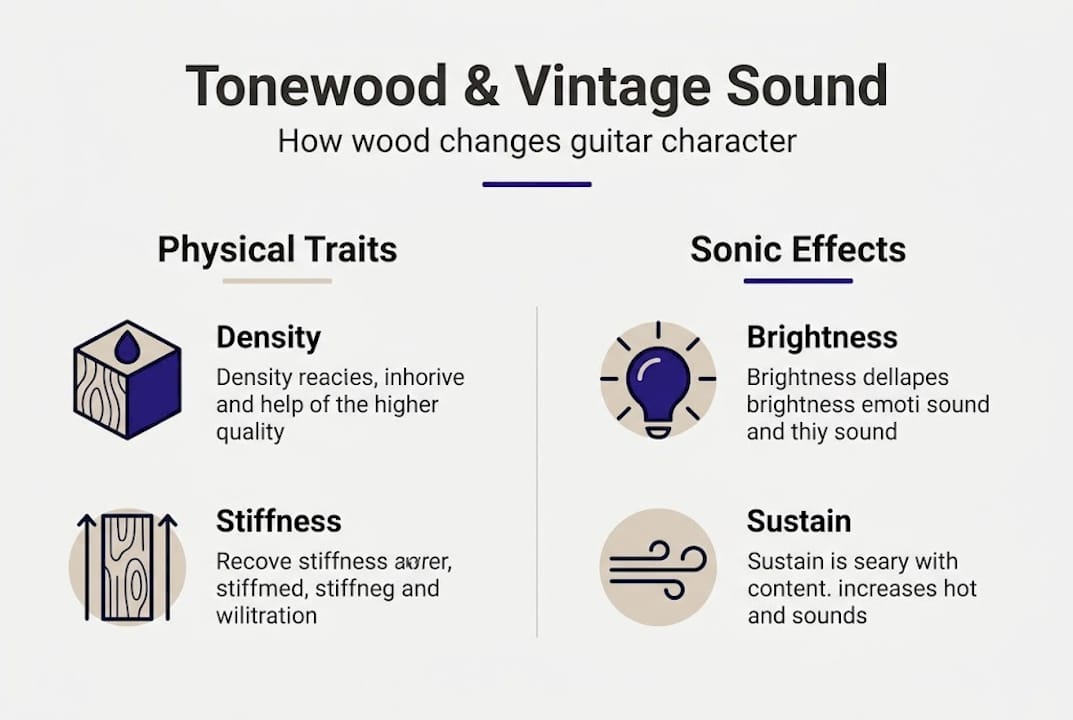
Wood affects sound through purely physical means. The mechanical properties of density, stiffness, and internal damping control how vibrations transfer from strings through the bridge and across the top. Each property shapes a distinct aspect of what you hear.
Density affects how quickly a guitar responds to a picked note, known as attack. Denser woods typically produce a tighter, more focused attack. Stiffness governs sustain and brightness. Stiffer tops ring out longer and with more clarity. Internal damping (expressed as tanδ in acoustic physics) controls how much vibrational energy a wood absorbs rather than radiates. Lower damping equals more sustain and projection. Higher damping equals a warmer, rounder tone that fades faster.
Moisture plays a huge role too. Research shows that moisture content can shift a wood’s viscoelastic damping and stiffness-to-density ratio by as much as 30%, meaning the same guitar can genuinely sound different depending on the climate it lives in. This isn’t audiophile myth. It’s measurable physics.
Here’s how these properties translate into what players actually hear and feel:
- Articulation: How distinctly individual notes separate in fast passages, influenced by density and stiffness
- Warmth: A rounded, full low-mid character tied to higher damping and softer woods like cedar
- Clarity: Upper-register definition favored by low-damping, high-stiffness tops like Sitka spruce
- Projection: How far and how evenly sound travels, shaped by the stiffness-to-weight ratio
- Sustain: How long notes ring out before fading, reduced by high internal damping
That said, these differences exist on a spectrum. Exploring wood density and guitar tone reveals that seasoned players often overestimate how dramatic wood swaps alone sound in controlled tests. Understanding why old guitars sound different requires looking at the whole picture, not just the species on the label.
How much does tonewood really matter? Science vs. perception
This is where the conversation gets genuinely interesting. Players and luthiers debate tonewood constantly, but controlled research adds some sobering nuance. A/B experiments using matched guitar builds with swapped soundboards show that differences can be real but are often smaller than expected, especially within the same broad wood category.
One key finding from acoustic research is that soundboard damping variation within typical real-world ranges produced changes that were not practically relevant in listener tests. This doesn’t mean tonewood is irrelevant. It means that the gap between a good piece of spruce and another good piece of spruce is often less audible than builders suggest.
| Scenario | Physical Difference | Perceptual Difference |
|---|---|---|
| Spruce vs. cedar top (same build) | Measurable stiffness and damping variation | Moderate, noticeable to trained ears |
| Two spruce tops, different grades | Small variation in damping | Often negligible in blind tests |
| Rosewood vs. mahogany back/sides | Density difference clear in lab | Subtle, context-dependent in playing |
| Same wood, different humidity history | Significant stiffness shift | Clearly audible in long-term aging |
Researchers control for confounding variables like top thickness, bracing geometry, and humidity when running these studies. What they consistently find is that construction decisions, especially bracing pattern and top thickness, often have more influence than the wood species alone.
Pro Tip: Before attributing a guitar’s tone entirely to its wood, check the setup. Nut height, saddle material, string gauge, and even neck relief all interact with the top’s natural resonance. A poorly set-up guitar built from “magic wood” will underperform a well-set guitar built from standard materials.
This is why why old guitars sound better is such a nuanced conversation. It’s rarely just the tree.
Environmental influences: Moisture, aging, and vintage character
Beyond wood species and construction, time and environment shape a guitar’s tone more than most buyers realize. This is especially relevant for vintage instruments, where decades of humidity fluctuation, finish wear, and repeated use leave a physical record in the wood itself.
Research confirms that humidity shifts wood’s viscoelastic properties, affecting both stiffness and damping. The damping coefficient reaches a minimum at around 6% equilibrium moisture content (EMC), which is roughly the level found in well-maintained storage conditions. Below or above that point, the wood loses some of its acoustic efficiency.
Here are the environmental factors that gradually reshape a vintage guitar’s sound:
- Moisture content changes: Seasonal humidity swings cause the wood to expand and contract, slowly altering grain structure and resonant properties
- Natural aging of resins: Organic compounds in the wood polymerize over decades, reducing internal damping and often improving sustain
- Finish wear and checking: As lacquer thins or cracks, the top vibrates more freely, contributing to the “opened up” quality of old guitars
- Repair and restoration history: Cracks, regluing, and finish touch-ups change mass distribution and stiffness across the top
- Regular playing: Consistent vibration from being played may contribute to structural settling, though this remains debated among researchers
Pro Tip: Store your vintage guitar at 45 to 55% relative humidity and between 65 and 75 degrees Fahrenheit. Rapid swings in either direction are far more damaging to tone and structure than a stable reading that’s slightly outside the ideal range.
These factors tie together wood types and sound with the real story of guitar aging and density in ways that no spec sheet can fully capture.
Tonewood and the vintage guitar market: What collectors should know
In the collector market, tonewood carries weight that goes beyond acoustics. Certain species became gold standards because of their historical association with landmark instruments. Brazilian rosewood, for example, commands a significant premium not just because it sounds exceptional but because CITES regulations have made it nearly impossible to obtain legally, and because the most celebrated pre-war and pre-ban guitars were built with it.
As noted in instrument research, tonewood selection impacts an instrument’s suitability and market value for collectors and enthusiasts, which is why originality matters so much. A replaced back or top can dramatically affect resale value, even if the replacement wood is technically superior.
For collectors, the practical checklist looks like this:
- Wood originality: Has the top, back, or neck been replaced? Factory original wood is almost always preferred by serious buyers
- Species documentation: Can the wood be verified through provenance records, factory stamps, or expert appraisal?
- Model history: Did this model historically use the wood present? Inconsistencies raise red flags
- Restoration quality: Was any repair work done by a skilled luthier, and does it preserve structural and tonal integrity?
- Rarity of species: Is the wood now restricted, discontinued, or increasingly difficult to source?
Non-standard woods don’t always hurt value. Some pre-production prototypes or artist editions used unusual combinations that now command premiums precisely because of their rarity. Context is everything. The guide to selecting handcrafted guitars walks through these evaluation criteria in practical detail.
The final myth worth busting: no single ingredient makes a great vintage guitar. It’s wood, craft, history, and the way those three things aged together.
A collector’s perspective: The real secret behind legendary vintage guitar tone
After years of handling, playing, and evaluating vintage instruments, one thing becomes clear. The guitars that leave a lasting impression rarely do so because of a single spectacular tonewood choice. They do it because every element landed right at the same time. The right builder, the right piece of wood, the right decade of climate, the right amount of play.
Obsessing over species alone is a trap. We’ve seen buyers pass on genuinely outstanding instruments because the top wasn’t Engelmann spruce or because the back wasn’t Brazilian rosewood. And we’ve seen those same buyers overpay for guitars with correct-spec woods that were cold, stiff, and lifeless. The wood is the beginning of the conversation, not the end.
Experienced collectors learn to trust their ears and their hands. They pick up the guitar unplugged and feel it vibrate in their chest. They look for resonance, liveliness, and that hard-to-name quality of a guitar that wants to be played. That quality is the result of every variable coming together, and understanding real reasons old guitars sound different is what separates a knowledgeable collector from someone chasing a checklist.
Appreciate the art. The ingredients matter, but they don’t tell the whole story.
Ready to experience vintage tonewood for yourself?
Knowing the science and the market dynamics is one thing. Holding a well-aged instrument and feeling it resonate is another experience entirely.

At Vintage Guitar World, every instrument in our collection comes with detailed documentation covering wood origin, construction history, and condition assessment. Whether you’re building your first serious collection or tracking down a specific tonewood combination, our guides to vintage guitar types and identifying collectible guitars give you the framework to buy with confidence. Browse the collection and bring this knowledge to life.
Frequently asked questions
What is the most important property of guitar tonewood?
The stiffness-to-weight ratio is widely considered the most critical factor for soundboards, as it directly governs both volume output and tonal clarity across the frequency range.
Does the type of wood really change how a vintage guitar sounds?
Yes, but controlled soundboard tests show that construction details, bracing, and instrument condition can be equally influential, especially when comparing woods within the same broad category.
How does humidity affect guitar tonewood?
Moisture content shifts a wood’s viscoelastic properties, meaning that changes in humidity alter both stiffness and internal damping, which directly affect tone and playability.
Is rare or exotic tonewood always better?
Not necessarily. Tonewood is only one factor in vintage guitar performance and value. Skilled craftsmanship, careful aging, and overall instrument condition consistently matter as much as the species itself.