













TL;DR:
- Patina is the natural aging and wear that add character and authenticity to vintage guitars.
- Genuine patina follows ergonomic patterns and cannot be convincingly faked like artificial relic’ing.
- Proper preservation involves gentle cleaning, controlling environment, and understanding the instrument’s aging signs.
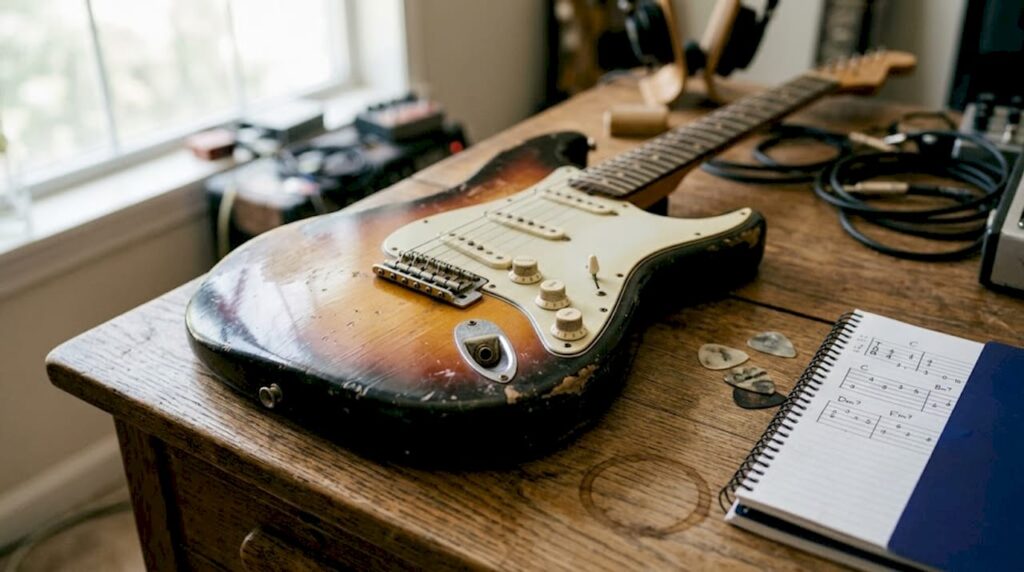
What if the scuffs, cracks, and tarnish on a vintage guitar aren’t flaws at all, but the most compelling part of the instrument? Many collectors new to the market assume wear equals damage. In reality, guitar patina refers to the natural aging and wear that gives an instrument its authentic, played-in character. From the fine spiderweb cracks in a nitrocellulose finish to the warm tarnish on decades-old tuning machines, patina is a visual biography. This article breaks down what patina is, how it forms, why collectors prize it, how to spot fakes, and how to care for it without erasing history.
Table of Contents
- Defining guitar patina: More than just wear
- How patina forms: Science and artistry behind aged finishes
- Natural vs. artificial patina: Authenticity and value
- Recognizing and preserving patina: A collector’s guide
- Why real patina matters more than perfection
- Discover more about vintage guitars and collectible patina
- Frequently asked questions
Key Takeaways
| Point | Details |
|---|---|
| Patina tells history | Guitar patina develops naturally over years, documenting an instrument’s use and unique journey. |
| Value in authenticity | Naturally aged patina is highly prized among collectors and can enhance a guitar’s desirability and worth. |
| Distinguishing wear types | True patina forms in logical patterns, while artificial relic’ing often displays random marks or mismatched features. |
| Preservation is key | Careful cleaning and expert advice help maintain patina’s beauty and collectible value. |
Defining guitar patina: More than just wear
The word “patina” comes from the Italian term for a thin layer that forms on metal surfaces over time. In the guitar world, it means something broader and more personal. Guitar patina refers to the natural aging and wear on vintage guitars, primarily the characteristic checking in nitrocellulose lacquer finishes, oxidation and tarnish on metal hardware, and wear patterns on high-contact areas, giving instruments an authentic played-in appearance.
Think of it as the guitar’s autobiography. Every faded patch near the soundhole, every dull spot on the back of the neck, every slightly green tuner button tells you something about where this instrument has been and who played it.
Patina typically shows up in several recognizable forms:
- Finish checking: Fine, spiderweb-like cracks across the lacquer surface, most common on nitrocellulose-finished guitars
- Color fading or ambering: UV exposure and oxidation shift the original finish color, often creating a warm, honey-like glow
- Wear spots: Thinned or missing finish in high-contact areas like the forearm rest, back of the neck, and around the soundhole
- Hardware tarnish: Oxidized tuning machines, bridge saddles, and pickup covers develop a muted, aged tone
- Texture changes: The finish may feel slightly different in aged zones, with a softer, almost silky quality in worn areas
“Patina is not carelessness. It’s the accumulated evidence of a life well-played.”
This is where many new collectors get confused. Patina and damage are not the same thing. Damage, such as structural cracks, broken headstocks, deep gouges into the wood, or failed repairs, can reduce a guitar’s value and playability. Patina, by contrast, stays on the surface. It does not compromise the instrument’s integrity. If anything, it confirms that the guitar is exactly what the seller claims it to be. For a deeper look at how wear is intentionally replicated on modern instruments, the guitar relicing basics guide explains the process and its limits.
The key distinction for any serious collector: patina tells a story, while damage raises questions. One adds to the instrument’s identity; the other subtracts from its reliability.
How patina forms: Science and artistry behind aged finishes
Patina is not random. It follows predictable patterns driven by materials, environment, and use. Understanding those patterns helps you read a guitar like a map.
Natural patina forms over decades through nitrocellulose oxidation, shrinking from temperature and humidity cycles creating checking, UV fading, player sweat causing hardware corrosion, and abrasion in forearm and pick zones. Each of those forces leaves a distinct signature.
Here’s a breakdown of the main factors:
- Nitrocellulose lacquer: This finish, used widely on vintage American guitars through the 1950s and 1960s, is thin and breathable. It oxidizes, shrinks, and checks in ways that modern polyester finishes simply cannot replicate.
- Temperature and humidity cycles: Wood expands and contracts. The lacquer does too, but at a different rate. Over years, this mismatch creates those fine checking patterns.
- UV light exposure: Sunlight bleaches and shifts pigments, creating the characteristic fading and color shift seen on many vintage sunburst finishes.
- Player contact: Sweat is mildly acidic. Over years of playing, it corrodes metal hardware and wears through finish in ergonomic zones.
- Abrasion: Picks, belt buckles, and forearm contact create distinct wear patterns that follow the natural geometry of how a guitar is held.
| Factor | Primary effect | Typical location |
|---|---|---|
| Nitro oxidation | Ambering, yellowing | Overall body and neck |
| Humidity cycling | Finish checking | Top, back, sides |
| UV exposure | Color fading | Top, headstock face |
| Sweat/oils | Hardware corrosion | Tuners, bridge, frets |
| Abrasion | Worn finish | Forearm area, back of neck |
Pro Tip: The location of wear is one of your most reliable clues. A guitar with heavy forearm wear but pristine hardware suggests it was played often but stored carefully. A guitar with tarnished tuners but a clean top may have been stored in a humid environment without much playing.
For collectors who want to maintain their instruments without erasing these signs of age, solid vintage guitar care practices make all the difference between preserving history and accidentally removing it.

Natural vs. artificial patina: Authenticity and value
The rise of the relic guitar market has made one thing clear: patina is desirable enough that people want to manufacture it. But can you fake decades of musical history? Experts say not convincingly.
Relicing artificially creates patina using thermal shock, sanding, and acids for finish and hardware wear, and it only works authentically on nitro finishes, not poly. The techniques can be impressive, but the results rarely fool a trained eye.
Here’s how the two compare:
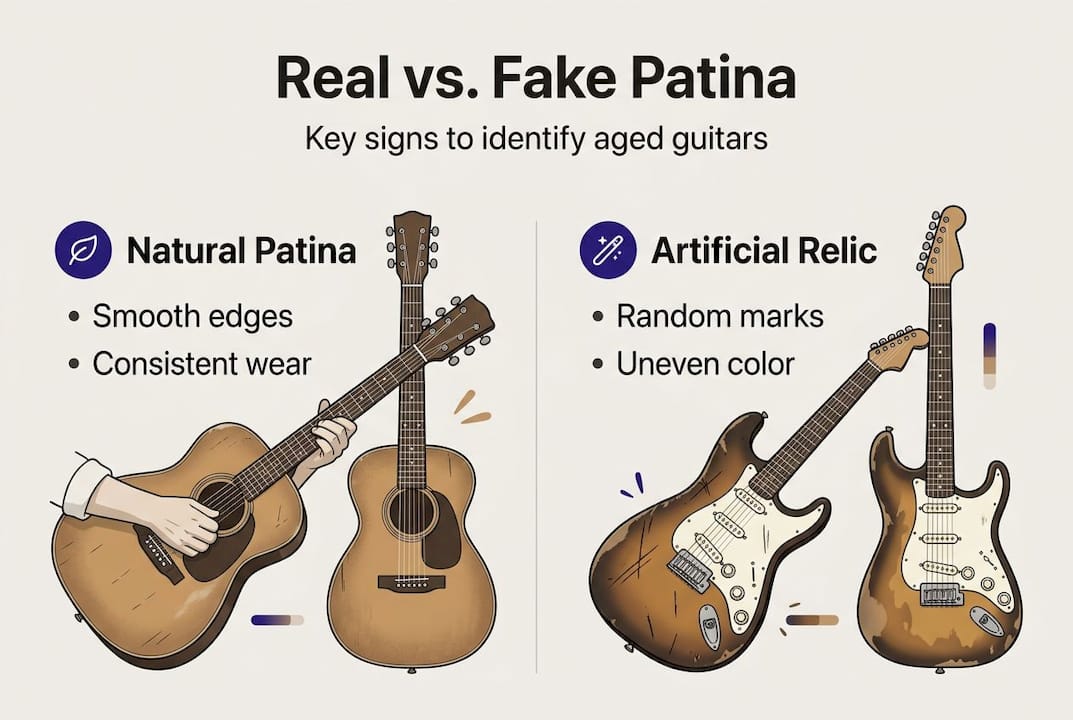
| Feature | Natural patina | Artificial relic’ing |
|---|---|---|
| Wear pattern | Ergonomic, logical | Often random or uniform |
| Hardware aging | Consistent with finish age | May be mismatched |
| Checking depth | Varies organically | Can look too uniform |
| Collector value | High, especially with provenance | Lower among purists |
| Finish type | Nitrocellulose | Nitrocellulose only |
How to spot the difference in practice:
- Check the hardware. Shiny tuners on a heavily checked body is a classic red flag. Natural aging affects the whole instrument over the same timeline.
- Look at wear locations. Real wear clusters around forearm contact zones, the back of the neck, and the area below the strings. Random scuffs elsewhere suggest artificial treatment.
- Examine checking patterns. Natural checking tends to vary in density. Artificially induced checking can look too consistent, almost like a pattern.
- Feel the edges. On naturally worn guitars, finish edges in worn areas are smooth from years of contact. Artificial wear may feel sharp or abrupt.
- Research the provenance. Documentation, original cases, and ownership history all support the claim of natural aging.
Poor relic’ing shows random wear or shiny hardware mismatches; genuine patina follows ergonomic patterns, and some view artificial relic’ing skeptically as it may not hold long-term value like natural aging.
Pro Tip: Before buying any “aged” guitar, run your finger along the forearm contour area. Natural wear feels polished and smooth. Artificial wear often has a slightly gritty or uneven edge.
Collector opinions on this topic are genuinely divided. Community discussions on relic’ing reveal a wide spectrum, from players who love the immediate mojo of a reliced guitar to purists who won’t consider anything that isn’t naturally aged. For a full breakdown of the process and the debate, the complete guide to relic’ing covers both sides thoroughly. If you’re serious about authenticating vintage guitars, understanding the difference between natural and artificial aging is non-negotiable.
Recognizing and preserving patina: A collector’s guide
Knowing what patina is and how it forms is only half the skill. The other half is knowing how to protect it once you find it.
Genuine patina follows the body’s natural interaction with the instrument. When examining a guitar, focus on these ergonomic zones:
- Forearm rest area: The lower bout where the strumming arm rests. Heavy wear here indicates years of regular playing.
- Back of the neck: Oils and sweat from the fretting hand gradually wear through the finish, often leaving a smooth, almost bare wood feel in extreme cases.
- Pickguard and surrounding area: Pick attack and hand position create distinctive wear patterns near the soundhole or pickups.
- Headstock face: UV exposure and handling create fading and finish wear here, especially around tuner buttons.
- Frets and fretboard: Fret wear and fretboard patina reveal how heavily and in which positions the guitar was played.
Genuine patina follows ergonomic patterns, and inconsistencies in those patterns are one of the clearest signs of artificial treatment.
When it comes to care, less is almost always more. Here are the core principles:
- Avoid aggressive polishing. Commercial guitar polishes, especially those with abrasives, can strip patina from a finish in minutes. Use only a dry or very lightly dampened cloth for routine cleaning.
- Don’t rush to remove tarnish. Hardware tarnish is part of the instrument’s story. Unless it’s actively corroding and threatening the guitar, leave it alone.
- Control the environment. Store vintage guitars at stable humidity (45 to 55 percent) and temperature. Avoid direct sunlight, which accelerates finish degradation beyond natural aging.
- Consult before restoring. If you’re considering any restoration work, get expert advice first. A well-intentioned cleaning can erase decades of authentic character.
Pro Tip: Before touching anything on a potentially valuable vintage guitar, photograph every detail in natural light. This creates a record of the instrument’s condition and can be invaluable for appraisal or insurance purposes.
For a thorough walkthrough of what to look for, the guide on checking guitar authenticity is an essential resource. If restoration is unavoidable, restoring guitar finishes the right way can preserve far more of the original character than most collectors expect.
Why real patina matters more than perfection
Here’s an opinion that might surprise some collectors: a mint-condition vintage guitar is not always the most valuable one. Not in any meaningful sense.
The market rewards provenance and authenticity. A 1959 Les Paul with honest checking, tarnished hardware, and documented ownership history carries something a pristine example often cannot: proof. Proof that it was played, that it existed in the hands of a musician, that it was part of the living tradition of the instrument.
Purists prize natural patina for its connection to tone and history, while relic fans value the immediate feel and playability without fear of adding new damage. Both perspectives have merit. But the market, over time, consistently rewards honest maturity.
Chasing “new old stock” condition at all costs can lead collectors to overlook instruments with far richer stories. We’d argue that the debates on relicing often miss the deeper point: patina isn’t about aesthetics alone. It’s about the irreplaceable connection between an object and its history. No factory process can manufacture that.
Discover more about vintage guitars and collectible patina
Ready to see patina in action and learn more about what makes vintage guitars so special? At Vintage Guitar World, we curate instruments where the history is part of the offering, not something to be polished away.

Whether you’re researching the types of vintage guitars and their unique aging characteristics, exploring why we love vintage guitars and what makes them irreplaceable, or simply ready to browse a collection of unique vintage guitars with authentic character, our platform connects you with expert-vetted instruments and the knowledge to appreciate them fully. Every guitar in our catalog comes with context, not just a price tag.
Frequently asked questions
What is guitar patina?
Guitar patina is the visible signs of natural aging and wear, including finish checking, tarnished hardware, and worn areas, that develop over years of playing and environmental exposure.
Does patina increase a guitar’s value?
Yes, naturally developed patina can increase a vintage guitar’s desirability and collector value, particularly when paired with documented provenance. Artificial relic’ing may not hold the same long-term value as genuine aging.
How can you tell if patina is real or artificial?
Genuine patina forms in logical, ergonomic wear patterns across the whole instrument, while artificial relic’ing often shows inconsistent marks and hardware that doesn’t match the finish’s apparent age.
What finish types allow real patina to develop?
Only vintage-style nitrocellulose lacquer finishes develop classic patina through checking and oxidation. Modern polyester finishes resist these effects and chip unnaturally rather than aging gracefully.
Does cleaning or polishing reduce patina?
Aggressive cleaning or polishing can remove patina quickly, so gentle care with a soft, dry cloth is strongly recommended for any vintage instrument you want to preserve.