














TL;DR:
- Originality, including factory finish and parts, is crucial for a vintage guitar’s value and authenticity.
- Fakes and refinishes significantly reduce a guitar’s worth, with detailed inspections revealing authenticity.
- Protecting a guitar’s original features preserves its historical story and collector’s worth.
Vintage doesn’t automatically mean valuable. That’s the misconception that costs collectors thousands every year. Many buyers assume age alone drives price, but seasoned dealers know the real driver is originality. A refinished guitar can lose up to 70% of its value compared to an all-original example, yet the two instruments can look nearly identical to an untrained eye. This guide walks you through what originality actually means, how to spot it in finishes, hardware, electronics, and documentation, and why protecting it matters far beyond the price tag.
Table of Contents
- Why originality matters in vintage guitars
- Identifying original finishes and components
- Advanced originality checks: Construction, electronics, and provenance
- The market impact of originality and common pitfalls
- What most guides miss: The collector’s deeper responsibility
- Explore, authenticate, and invest with confidence
- Frequently asked questions
Key Takeaways
| Point | Details |
|---|---|
| Original finish is key | A factory-original finish preserves value and collector interest more than any other factor. |
| Small changes mean big losses | Refinishing or hardware swaps can drop a vintage guitar’s value by up to 70%. |
| Authentication needs expertise | Verifying originality involves construction, electronics, and provenance; get expert help for costly pieces. |
| Documentation matters | Provenance and paperwork significantly boost authenticity claims and resale value. |
Why originality matters in vintage guitars
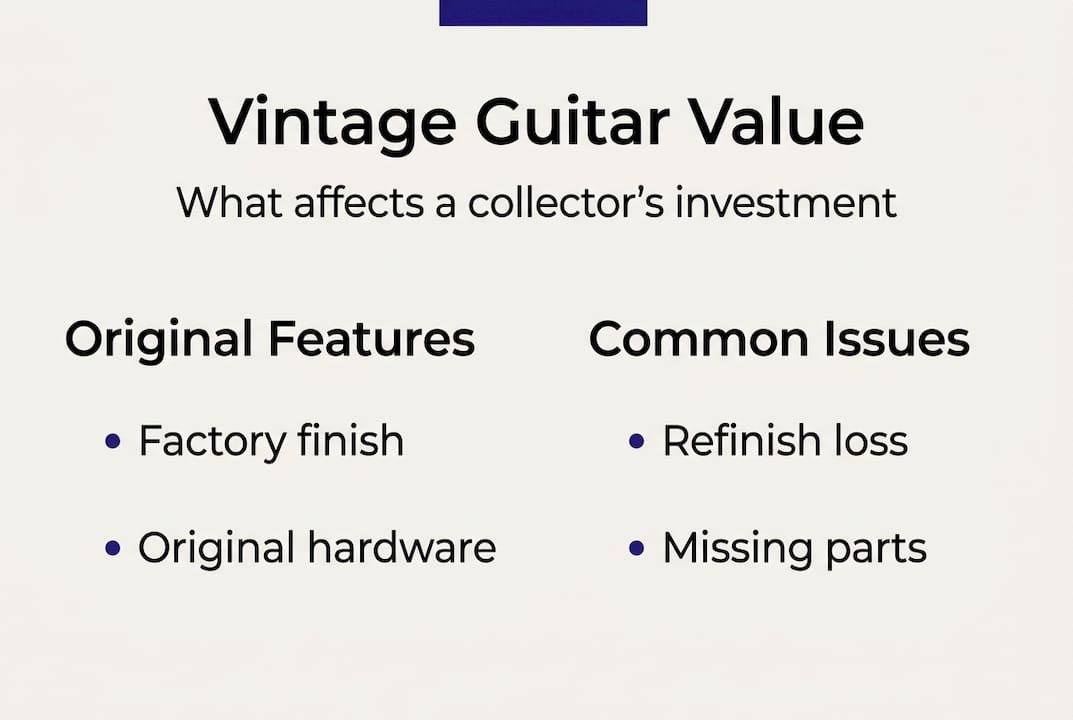
Originality, in the collector’s world, means one thing: the guitar left the factory and stayed that way. Factory finish intact. Original hardware in place. Documentation that traces the instrument’s life. When any of those elements change, the guitar’s story gets rewritten, and not in a good way.
The market responds harshly to alterations. A replaced tuner set, a touched-up headstock, a refret with the wrong wire gauge — each of these chips away at both monetary value and historical integrity. Gruhn’s Guide has long been the reference standard for understanding factory specifications, and it makes clear that period-correct details are non-negotiable for serious collectors.
Here’s what actually contributes to a vintage guitar’s value:
- Factory finish: Untouched original lacquer, even if worn, is worth far more than a professional respray
- Original parts: Tuners, pickups, bridges, and nuts should match the production year’s specifications
- Documentation: Case candy, receipts, hang tags, and inspection slips add measurable value
- Honest wear: Natural play wear tells a guitar’s story; it’s preferred over cosmetic repairs
- Matching serial numbers: Labels, stamps, and serials should align with known factory records
“Originality prioritizes factory finish and parts over play wear; honest aging is always preferred to refinishes or replaced components.”
This is the part that surprises many new collectors. Wear is good. A 1959 Les Paul with buckle rash, fret wear, and a faded top is telling you it was played and loved. That’s authentic. A 1959 Les Paul with a fresh respray and new tuners is telling you someone made decisions that erased part of its history.
For musicians, originality also matters beyond resale. Playing a guitar with its original components means experiencing the instrument as its maker intended. The tonal character of aged pickups, the feel of original frets, the resonance of a finish that has cured for decades — these are not romantic notions. They are real, audible differences. Understanding why collectors love vintage guitars goes hand in hand with understanding why originality is the foundation of that love.
Identifying original finishes and components
The finish is your first and most telling clue. Most vintage guitars from the 1950s through the early 1970s were finished in nitrocellulose lacquer, a thin, solvent-based coating that ages in very specific, recognizable ways. Modern polyurethane finishes, used on most production guitars today, behave completely differently.
Knowing how to read a finish is a foundational skill for any serious collector. Finish originality is critical; refinished guitars lose 40 to 70% of their value. Here’s how to compare what you’re looking at:
| Feature | Original nitro finish | Refinished or poly finish |
|---|---|---|
| Checking pattern | Fine, irregular crazing across surface | Absent or artificially induced |
| Thickness | Extremely thin, almost skin-tight | Noticeably thick, plastic-like feel |
| Aging color | Amber or yellowed naturally | Uniform, unnaturally bright |
| Ghosting | Visible outlines of hardware under finish | Not present |
| UV reaction | Fades and yellows under UV light | Minimal UV reaction |
| Feel | Slightly rough or matte in aged areas | Smooth, glassy throughout |
Checking, that fine web of cracks across the surface, happens as nitro lacquer contracts and expands over decades. It cannot be convincingly faked at scale. Crazing refers to deeper, more pronounced cracking, often found near binding or on the top. Ghosting is one of the most reliable tells: when original hardware sits on a finish for 50 years, it leaves a shadow outline. If you remove the pickguard and see a clean, unmarked surface underneath, that finish is almost certainly a replacement.
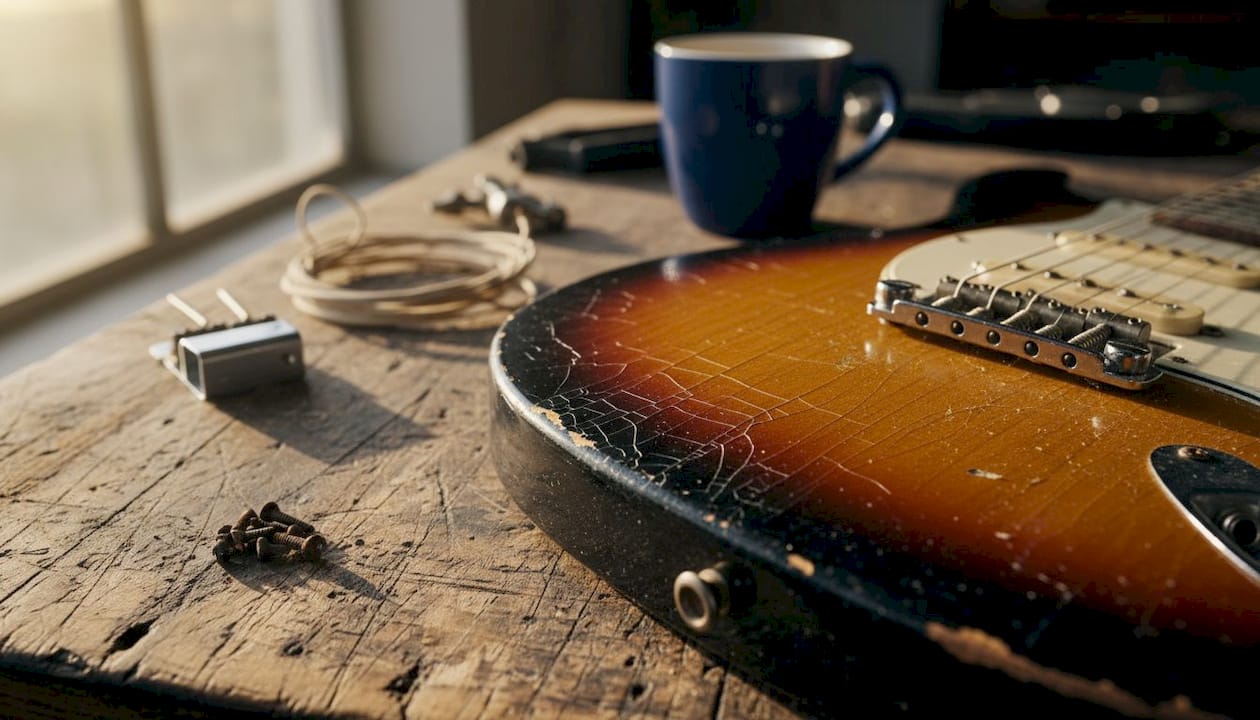
Pro Tip: Bring a small UV flashlight to any in-person inspection. Nitrocellulose lacquer fluoresces differently than polyurethane under UV light, giving you a fast, non-invasive way to flag potential refinishes before you go deeper.
For hardware, cross-reference everything against known production specs. A 1963 Fender Stratocaster should have specific tuner styles, a specific pickup cover material, and a specific bridge saddle design. Resources like vintage specs and serials give you the exact factory details to compare against. When checking guitar authenticity, work from a checklist and never rely on memory alone. And if you want to go hands-on before committing, testing vintage guitars in person remains the gold standard.
Advanced originality checks: Construction, electronics, and provenance
Once you’ve assessed the surface, it’s time to go deeper. The most convincing fakes and the most costly misidentifications happen at the construction and electronics level. This is where experience and reference materials matter most.
Here is a structured diagnostic approach:
- Headstock and body joinery: Check the volute shape, truss rod access style, and headstock angle. These details changed by year and model. Mismatched joinery or inconsistent wood grain at the neck joint can indicate a replaced neck.
- Electronics and wiring: Original wiring harnesses use period-specific pots, capacitors, and cloth-covered wire. Replacement electronics are common and often undisclosed. Look for solder joints that match the era and components that carry correct date codes.
- Serial and label verification: Cross-reference the serial number against known factory records. Interior labels on acoustics, stamps on electric necks, and pot codes on electronics all provide independent date verification.
- Provenance records: Original receipts, previous owner documentation, and even old photographs of the instrument in use add layers of authentication that no forger can easily replicate.
A detailed authenticity guide for the Gibson ES-335 illustrates just how many data points align in a genuine example: headstock construction, center block dimensions, F-hole geometry, electronics, and provenance all need to match. Expert authentication requires aligning multiple diagnostics, and professional evaluation is strongly recommended for high-value instruments.
For any guitar above a certain price threshold, the cost of an expert evaluation is trivial compared to the risk of buying wrong. When identifying rare guitars, the stakes are simply too high to rely on seller descriptions alone. A structured process for authenticating vintage guitars gives you a repeatable framework that removes guesswork.
The market impact of originality and common pitfalls
The numbers are unambiguous. Refinished guitars lose 40 to 70% of their value compared to fully original examples. Here’s how that plays out across condition categories:
| Condition | Relative market value | Notes |
|---|---|---|
| All-original, excellent | 100% (baseline) | Factory finish, parts, and docs intact |
| All-original, heavy wear | 60 to 80% | Honest wear accepted; value preserved |
| Refinished, all-original parts | 30 to 60% | Finish loss is the biggest value hit |
| Refinished, replaced parts | 15 to 35% | Compound alterations severely reduce value |
| Modified or heavily repaired | 10 to 25% | Structural or electronic changes most damaging |
The most common pitfalls collectors fall into include:
- Non-period replacement parts: Tuners, pickups, or bridges swapped for modern equivalents, even quality ones
- Undisclosed finish work: Touch-ups, spot repairs, or full resprays that sellers describe as “original with light work”
- Amateur repairs: Poorly executed crack fills, headstock breaks repaired without professional care, or mismatched fret wire
- Missing original hardware: Pickguards, knobs, and covers that were replaced and the originals discarded
- Misrepresented provenance: Ownership histories that cannot be verified or documentation that doesn’t match the instrument
Pro Tip: Always request high-resolution photographs of the headstock, back of the neck joint, interior label, and electronics cavity before purchasing remotely. Written verification of any known repairs or alterations should be a non-negotiable condition of sale.
The vintage buying checklist is a practical tool for structuring your evaluation process. For a deeper framework on condition grading, the used guitar evaluation guide covers the full spectrum from mint to player-grade. A solid guitar appraisal overview will also help you understand how professionals weigh each factor.
What most guides miss: The collector’s deeper responsibility
Most originality guides frame the conversation around money. And yes, the financial stakes are real. But there’s a dimension that gets overlooked: stewardship.
Every original vintage guitar is a physical record of how instruments were built at a specific moment in history. The way a 1950s Gibson neck was shaped, the specific alloy in a Fender pickup cover, the hand-applied finish on a pre-war Martin — these details exist nowhere else in the world. When collectors refinish, modify, or “improve” these instruments, they erase evidence that can never be recovered.
We think about this constantly when we evaluate instruments. The question isn’t only “what is this worth?” It’s “what does this instrument tell us, and are we protecting that story for the next person who will own it?” Knowing the signs of collectible guitars is the beginning of that responsibility, not the end of it.
The most respected collectors we’ve encountered treat originality as a form of respect for the craftspeople who built these instruments decades ago. That perspective changes how you evaluate, how you buy, and how you eventually sell.
Explore, authenticate, and invest with confidence
Understanding originality is one thing. Finding instruments that meet that standard is another challenge entirely. At Vintage Guitar World, every instrument in our catalog goes through rigorous evaluation before it reaches you.

Whether you’re building a serious collection or searching for a player-grade vintage instrument with honest wear, we give you the documentation, photographs, and expert context to buy with confidence. Explore our expert guitar appraisal guide to understand how we grade instruments, browse vintage guitar types and history to sharpen your knowledge, or go straight to our shop for authentic vintage guitars and see what’s currently available.
Frequently asked questions
How can I tell if a vintage guitar has its original finish?
Look for nitrocellulose lacquer characteristics like fine checking, crazing, ghosting under removed hardware, and the absence of thick polyurethane. Refinished guitars typically lack these natural aging patterns and often feel noticeably thicker to the touch.
Does replacing tuners or hardware ruin a guitar’s originality?
Yes, replacing original hardware reduces both value and collector desirability. Originality prioritizes factory parts over cosmetic condition, so keeping original components, even worn ones, is always the better choice.
How much does a refinish decrease a vintage guitar’s value?
A refinish can reduce value by 40 to 70% compared to a fully original example, making finish integrity the single most important factor in investment-grade instruments.
Why is provenance important in verifying originality?
Provenance documents a guitar’s ownership history and provides independent evidence that supports authentication. Expert authentication aligns multiple diagnostics, including provenance, to build a complete picture of an instrument’s legitimacy.
What are the best resources for checking vintage guitar specs?
Gruhn’s Guide to Vintage Guitars provides detailed specifications, serial number ranges, and model histories. Pairing it with a professional appraisal service gives collectors the most reliable foundation for any significant purchase.