













The oldest guitar in the room is not always the most valuable one. That assumption trips up collectors and musicians every day, leading to overpaying for age and overlooking instruments with far greater significance. Historical context, meaning the era, cultural moment, construction methods, and documented story behind a guitar, shapes its tone, rarity, and investment worth in ways that raw age simply cannot. Understanding this distinction gives you a real edge when buying, selling, or simply appreciating what you hold in your hands.
Table of Contents
- Why historical context matters in guitars
- Era comparison: Pre-war, post-war, and modern guitars
- Craftsmanship and materials: The heart of historical significance
- Provenance and documentation: Building a guitar’s story
- Expert perspectives: Nuance and collector strategies
- Explore, compare, and invest in historic guitars
- Frequently asked questions
Key Takeaways
| Point | Details |
|---|---|
| Era shapes value | A guitar’s historical period affects its craftsmanship, rarity, and collectible worth. |
| Provenance matters | Detailed history and documentation can boost a guitar’s value by up to 35 percent. |
| Materials impact tone | Aging wood, original parts, and vintage techniques give older guitars unique sound qualities. |
| Condition trumps age | Well-preserved post-war guitars may rival older models in sound and investment potential. |
| Expert insight is key | Understanding nuances and myths helps collectors make smarter choices. |
Why historical context matters in guitars
Historical context in the guitar world goes well beyond a manufacture date stamped inside a soundhole. It covers the era in which a guitar was built, the cultural forces driving its design, the maker’s philosophy, and the materials available at the time. Each of these factors leaves a fingerprint on the instrument that collectors and musicians learn to read.
No era illustrates this better than the pre-war period. Pre-war guitars built before 1942 are widely regarded as the peak of acoustic craftsmanship, featuring hand-selected tonewoods, scalloped bracing, hide glue construction, and limited production runs that produced instruments of extraordinary tone and rarity. That combination of factors is why a pre-war Martin or Gibson commands prices that post-war equivalents rarely match.
Here are the key elements that form a guitar’s historical backdrop:
- Era of production: Pre-war, post-war, or modern manufacturing context
- Maker and workshop: Individual luthier versus factory production
- Design innovation: Dreadnought introduction, cutaway evolution, electric pickup integration
- Cultural moment: Depression-era scarcity, post-war boom, folk revival, rock explosion
- Materials available: Old-growth tonewoods versus modern sustainable alternatives
Pre-war guitars represent a peak craftsmanship era defined by hand-selected tonewoods, scalloped bracing, hide glue, and limited production, producing superior tone, rarity, and collector value that modern instruments rarely replicate.
Collectors who understand these layers do not just buy guitars. They buy documented moments in instrument-making history.
Era comparison: Pre-war, post-war, and modern guitars
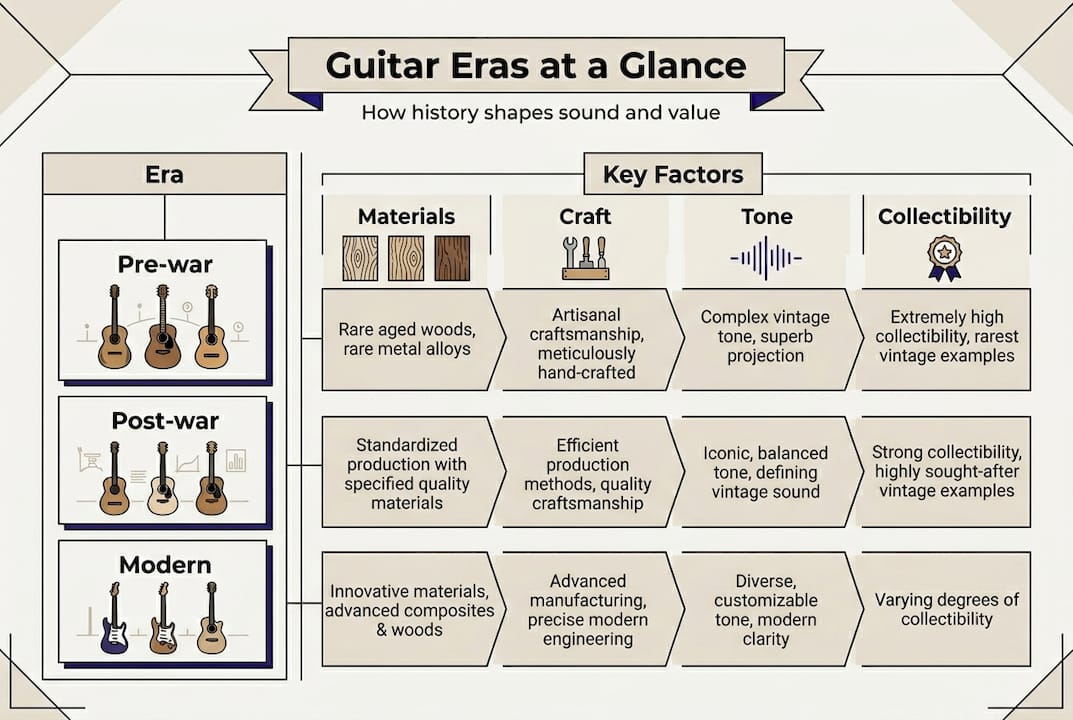
Every era leaves distinct marks on the guitars it produces. Comparing them side by side helps you recognize what you are looking at and understand why the market prices instruments the way it does.
| Feature | Pre-war (up to 1942/49) | Post-war (1950s to 1980s) | Modern (1990s to present) |
|---|---|---|---|
| Construction | Hand-crafted, hide glue | Mixed hand/machine, newer adhesives | Largely machine-assisted |
| Tonewoods | Old-growth, hand-selected | Good quality, less selective | Sustainable, regulated species |
| Bracing | Scalloped, hand-carved | Transitional styles | Computer-optimized |
| Rarity | Very high | Moderate to high | Low to moderate |
| Typical premium | 20 to 35% above post-war | Varies by model and condition | Market price baseline |
| Collector demand | Extremely high | Strong for iconic models | Growing for limited runs |
If you love vintage guitars, this table tells a story: pre-war instruments carry a premium rooted in scarcity and superior build, while post-war models offer a compelling middle ground. Pre-war value statistics confirm that hand craftsmanship and rare tonewoods drive values up by 20 to 35%, with provenance pushing that figure even higher.
Factors collectors use to distinguish eras include:
- Serial number ranges cross-referenced with manufacturer records
- Bracing style visible through the soundhole
- Finish type: nitrocellulose lacquer versus polyester
- Hardware details: open-back tuners, bone nuts, period-correct bridges
- Headstock shape and logo evolution
It is worth noting that some post-war models, particularly well-preserved 1950s Gibsons or early 1960s Martins, rival pre-war quality when craftsmanship in guitars and originality are both exceptional. Era is a starting point, not a final verdict.
Craftsmanship and materials: The heart of historical significance
Materials and construction methods are where historical significance becomes tangible. You can feel it in the resonance of an aged spruce top and hear it in the complex overtones that newer builds rarely produce.
| Material or method | Pre-war | Post-war | Modern |
|---|---|---|---|
| Top wood | Old-growth Adirondack spruce | Sitka spruce (younger growth) | Sitka, cedar, or alternatives |
| Back and sides | Brazilian rosewood, mahogany | Indian rosewood, mahogany | Ovangkol, walnut, certified woods |
| Adhesive | Hide glue | Titebond and synthetics | Synthetic adhesives |
| Bracing | Hand-carved scalloped | Factory scalloped or non-scalloped | CNC-cut, optimized |
| Finish | Thin nitrocellulose | Nitrocellulose or early poly | Polyester or thin satin |
The science behind aged tone is well established. Wood aging over 30 to 50 years causes moisture loss that enhances clarity and resonance, and when combined with skilled craftsmanship, produces complex overtones that newer instruments simply have not had time to develop. Understanding guitar aging and tone helps you evaluate whether a vintage instrument has aged gracefully or suffered from neglect.
Hide glue, used in virtually all pre-war construction, flexes slightly over time in a way that synthetic adhesives do not. This flexibility allows the top to vibrate more freely, contributing to the warmth and responsiveness that players describe as “alive.” Hand-carved braces add another layer of tonal individuality because no two are identical.
Pro Tip: Originality beats raw age every time for investment purposes. An unmodified 1940 guitar with its original tuners, bridge, and finish is worth significantly more than a same-year instrument with replaced parts, even if the replacements are high quality. Understanding guitar aging value helps you price this difference accurately before you buy.
Modern guitars offer consistency and playability that vintage instruments sometimes cannot match. But they trade tonal complexity for reliability. Neither is wrong. Knowing which you need is the real skill.
Provenance and documentation: Building a guitar’s story
A guitar’s physical condition tells part of its story. Its documented history tells the rest. Provenance, meaning the verified chain of ownership and associated records, can transform a collectible into an investment-grade asset.
Here is how to check and secure provenance before purchasing:
- Request the serial number and cross-reference it with manufacturer records or published databases
- Ask for original receipts, warranty cards, or period photographs showing the instrument
- Research ownership history through seller documentation, auction records, or estate paperwork
- Verify any musician association with concert programs, photographs, or signed letters of authenticity
- Consult a specialist for formal appraisal and certification before finalizing a significant purchase
Documentation is not just paperwork. Provenance and documentation can boost a guitar’s value by 20 to 35%, and a confirmed association with a notable musician can push it into an entirely different investment category. Understanding guitar provenance explained is essential before you spend serious money.
Only 91 pre-war Martin D-45 guitars were produced before World War II, making each surviving example extraordinarily rare. Documentation confirming one of these instruments is what separates a high-value collectible from a life-changing asset.
Pro Tip: If a seller cannot provide at least a serial number and basic ownership history, treat the asking price with skepticism. Legitimate sellers of investment-grade instruments expect documentation requests. A thorough guitar appraisal process will also flag any inconsistencies between claimed provenance and physical evidence.
Provenance also matters for insurance and resale. Insurers require documentation to cover instruments at replacement value, and future buyers will ask the same questions you should be asking now. Building a complete file from the moment of purchase protects your investment for decades.
Expert perspectives: Nuance and collector strategies
Experienced collectors know that the market rewards nuance. A few persistent myths can cost you real money if you accept them without question.
Common myths worth challenging:
- “Oldest always means best”: A poorly stored 1930s guitar with cracks, replaced parts, and a warped neck can be worth less than a pristine 1960s example
- “All modifications reduce value”: Period-correct repairs by respected luthiers can preserve or even enhance value when documented properly
- “Pre-war is always the target”: Some collectors specifically seek post-war models for their playability and tonal consistency
- “Vintage always beats modern for tone”: Many professional players prefer modern builds for touring because of their stability in varying climates
- “Rarity alone drives price”: A rare guitar nobody wants is still a guitar nobody wants. Demand must meet rarity for value to follow
Condition and originality consistently outweigh age in expert evaluations. A well-preserved post-war instrument with all original components can rival a pre-war guitar that has been heavily repaired or modified. This is the nuance that separates informed buyers from those who simply chase the oldest label.
For practical buying decisions, blend period research with current market data. Study recent auction results, consult guitar appraisal advice from certified specialists, and learn the specific features that make a model desirable within its era. Knowing how to identify collectible guitars by their physical characteristics gives you confidence at the point of purchase.
The best collectors combine historical knowledge with market awareness and hands-on experience. No single factor tells the whole story.
Explore, compare, and invest in historic guitars
Understanding historical context is the foundation of every smart guitar purchase. Now it is time to put that knowledge to work.

At Vintage Guitar World, we have built a knowledge base specifically for collectors and musicians who want to buy with confidence. Whether you are learning about types of vintage guitars across different eras, working through a formal guitar appraisal expert guide before a major purchase, or ready to browse vintage guitars from our curated selection of rare and restored instruments, we are here to support every step. Our team evaluates every instrument for authenticity, originality, and condition so you can invest with clarity.
Frequently asked questions
What makes pre-war guitars so highly valued?
Pre-war guitars are prized for hand-selected tonewoods, scalloped bracing, hide glue construction, and extremely limited production runs that produced instruments with superior tone and enduring collector demand.
How does provenance affect guitar value?
A documented ownership history or confirmed association with a notable musician can boost guitar value by 20 to 35% or more, moving an instrument from collectible to investment-grade status.
Is age or condition more important for collectible guitars?
Condition and originality consistently outweigh age in expert evaluations. A well-preserved post-war guitar with all original components can rival or exceed the value of an older instrument that has been heavily modified or poorly maintained.
Does wood aging really change a guitar’s sound?
Yes. Wood aging over 30 to 50 years reduces moisture content, which increases resonance and tonal complexity, producing the warmth and overtone richness that vintage instruments are known for.