














You’ve found the perfect vintage guitar, but the seller can’t provide much history beyond a vague story. Should you walk away? Many collectors assume provenance is just bureaucratic paperwork, a nice-to-have that dealers use to justify premium prices. The reality is far more consequential. Guitar provenance serves as your primary defense against forgeries, your leverage in negotiations, and your insurance policy for future resale. Understanding how to evaluate and establish provenance separates informed collectors from those who overpay for questionable instruments or miss opportunities on undervalued gems.
Table of Contents
- Key takeaways
- Understanding guitar provenance: Definition and significance
- How to establish guitar provenance: Documentation and authentication methods
- Navigating challenges and nuances in guitar provenance verification
- Applying guitar provenance to investment and collection strategies
- Explore vintage guitars with verified provenance today
- Frequently asked questions about guitar provenance
Key Takeaways
| Point | Details |
|---|---|
| Provenance boosts value | Provenance can increase investment grade guitars by roughly fifteen to fifty percent or more, reflecting reduced uncertainty for buyers. |
| Documentation plus authentication | Establishing provenance relies on combining documentary records with physical authentication to verify originality. |
| Partial provenance adds value | Even without full documentation, solid physical authenticity and a plausible ownership history can still command a premium. |
| Expert scrutiny essential | Because forgeries are rampant, expert evaluation helps verify maker, model, and year. |
Understanding guitar provenance: Definition and significance
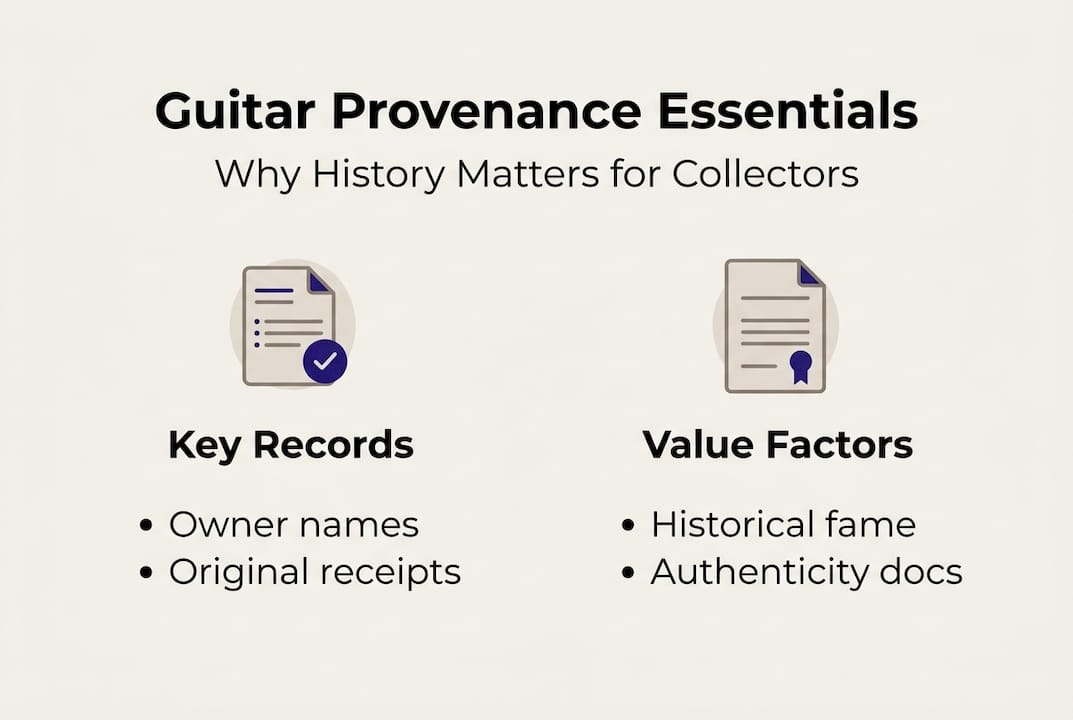
Guitar provenance refers to the documented chain of ownership and historical record of an instrument from its manufacture to the present day. This history establishes authenticity, verifies originality, and connects the guitar to specific periods, makers, or notable previous owners. For vintage guitar collectors, provenance transforms an instrument from a simple musical tool into a historical artifact with verifiable credentials.
The significance of provenance extends far beyond academic interest. Provenance transforms guitars into historical artifacts with verified ownership, increasing value by 15-50% or more for investment-grade instruments. This value premium reflects reduced risk for buyers, who gain confidence that they’re acquiring an authentic piece rather than a sophisticated forgery or heavily modified example misrepresented as original.
Provenance serves multiple critical functions for serious collectors:
- Authentication of maker, model, and year through traceable ownership records
- Legal protection establishing clear title and ownership rights
- Historical context connecting the instrument to specific eras or notable musicians
- Investment security through documented value and authenticity for insurance and resale
- Fraud prevention by exposing gaps or inconsistencies in ownership claims
The importance of provenance has intensified as vintage guitar values have climbed. A 1959 Gibson Les Paul Standard with complete provenance can command twice the price of an identical guitar with murky history, even when both instruments show similar physical condition. This price differential reflects the market’s recognition that documentation reduces uncertainty and liability.
For collectors focused on why we love vintage guitars, provenance adds a narrative dimension that enhances ownership satisfaction beyond the instrument’s playing qualities. Knowing your 1964 Fender Stratocaster belonged to a session musician who recorded with notable artists creates emotional connection and cultural significance that pure specifications cannot provide.
The legal dimension deserves emphasis. Provenance establishes rightful ownership and protects against claims from previous owners or allegations of stolen property. Without clear documentation, even legitimately purchased guitars can become legal liabilities if ownership disputes arise years after acquisition.
How to establish guitar provenance: Documentation and authentication methods
Establishing provenance requires combining documentary evidence with physical authentication techniques. No single method provides absolute certainty, but layering multiple verification approaches builds confidence and reveals inconsistencies that indicate problems.
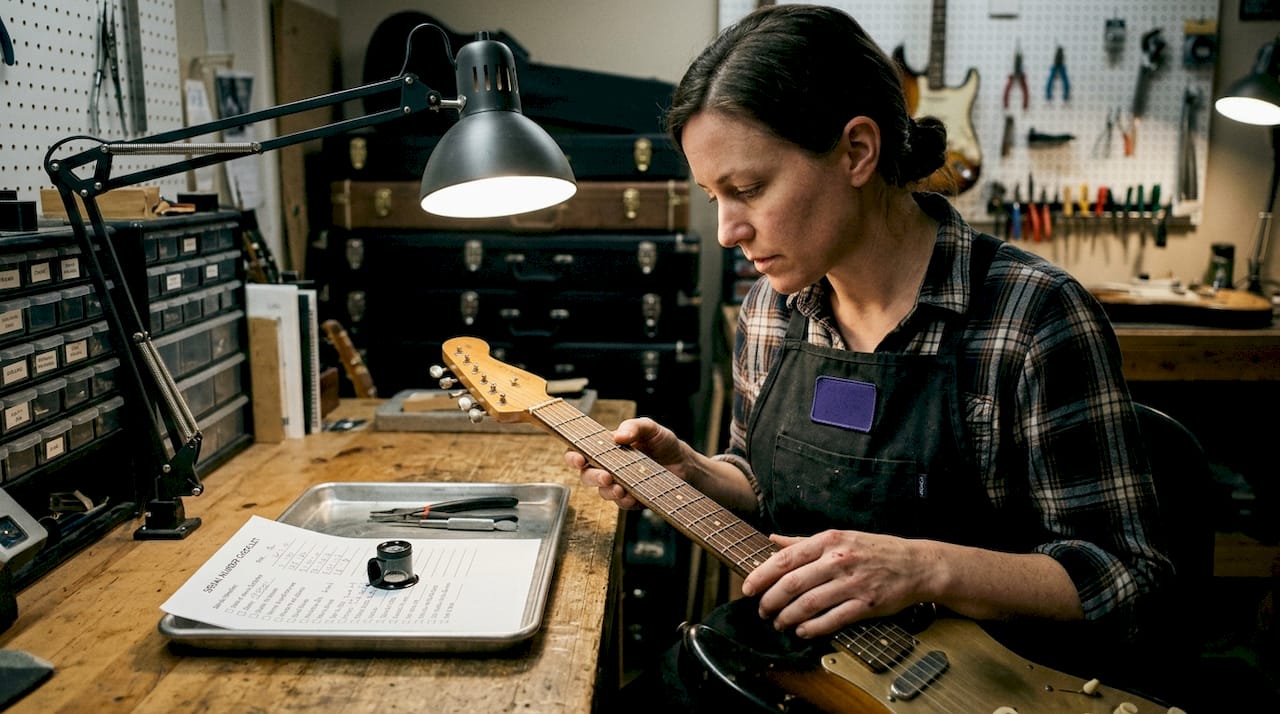
Key methodologies include tracing ownership via documents, manufacturer records, and physical authentication checklists. Documentary evidence forms the foundation of provenance research. Collectors should seek provenance letters detailing ownership history, certificates of authenticity from reputable experts or dealers, professional appraisals with detailed descriptions, historical photographs showing the instrument with previous owners, original purchase receipts or invoices, and correspondence or documentation from the manufacturer.
Manufacturer records provide crucial verification for certain brands. Gibson maintains shipping records for many vintage instruments that confirm original specifications and destination. Fender offers similar services for guitars manufactured since the 1950s. Martin Guitar Company archives contain detailed production records dating back decades. However, these resources have limitations. Many early records were lost, destroyed, or never systematically maintained. Manufacturers typically charge fees for archive searches and may require weeks or months to process requests.
Physical authentication examines the instrument itself for period-correct features and construction methods. Expert luthiers and appraisers evaluate:
- Hardware specifications matching documented production periods
- Wood grain patterns and aging consistent with claimed age
- Finish checking and wear patterns indicating genuine age versus artificial distressing
- Internal construction details like bracing patterns and glue types
- Wiring configurations and component values matching original specifications
- Serial numbers and factory order numbers decoded against manufacturer databases
Scientific analysis uses spectrometers, UV light, chemical tests, and serial/FON decoding for verification. Advanced authentication services employ ultraviolet light examination to reveal finish repairs and alterations, infrared spectroscopy to analyze wood species and age, chemical testing of finish materials to confirm period-appropriate formulations, and digital databases comparing component specifications against known original examples.
Pro Tip: Cross-reference multiple authentication methods rather than relying solely on documentation. A certificate of authenticity means nothing if the physical guitar shows wrong-period components or construction inconsistencies. Start with visual inspection, then seek documentary support.
| Authentication method | Strengths | Limitations |
|---|---|---|
| Documentary evidence | Establishes ownership chain, provides legal protection | Can be forged, may have gaps |
| Manufacturer records | Authoritative source for original specs | Incomplete archives, processing delays |
| Physical inspection | Reveals modifications and inconsistencies | Requires expert knowledge, subjective |
| Scientific analysis | Objective data on materials and age | Expensive, requires specialized equipment |
The most reliable provenance combines all approaches. For guitar authenticity guide purposes, documentary evidence supported by physical authentication and manufacturer confirmation provides maximum confidence. When evaluating a potential purchase, consult the vintage guitar buying checklist to ensure you’re addressing all verification dimensions.
Navigating challenges and nuances in guitar provenance verification
Provenance verification presents numerous challenges that complicate even careful collectors’ efforts. Understanding these obstacles helps you make realistic assessments and avoid common pitfalls that lead to expensive mistakes.
The most fundamental challenge involves incomplete or missing documentation. Vintage guitars change hands multiple times over decades, and ownership records often disappear through estate sales, divorces, moves, or simple neglect. Each ownership transfer without documentation creates a gap that weakens the overall provenance chain. After multiple resales, even guitars with strong early provenance may have only fragmentary recent history.
70% of signed guitar authentication requests are fake; counterfeits surpass drug trafficking in organized crime impact. This staggering statistic reveals the scale of fraud in the vintage guitar market. Forged certificates of authenticity, fabricated provenance letters, and doctored photographs appear regularly. Sophisticated criminals understand that provenance documentation commands premium prices and invest significant effort creating convincing forgeries.
Authentication becomes particularly difficult when dealing with celebrity-owned instruments. Signatures can be forged, and unscrupulous sellers fabricate connections to famous musicians. Without rock-solid documentation like photographs of the celebrity with the specific instrument, bills of sale, or direct provenance from the artist’s estate, celebrity ownership claims should trigger extreme skepticism.
Manufacturer limitations create additional complications. No retroactive Gibson COAs pre-1988; stories and provenance dilute over resale cycles. Gibson does not issue certificates of authenticity for guitars manufactured before 1988, meaning collectors must rely entirely on physical authentication and third-party documentation for the most desirable vintage instruments. Fender and Martin have similar policies limiting official documentation for their earliest production.
Red flags that should trigger additional scrutiny include:
- Provenance documentation that lacks specific details like dates, locations, or transaction values
- Certificates of authenticity from unknown or non-specialist authenticators
- Ownership claims that cannot be verified through independent sources
- Prices significantly below market value for instruments with claimed strong provenance
- Sellers reluctant to allow independent expert examination before purchase
- Documentation inconsistencies like mismatched dates or conflicting ownership timelines
Pro Tip: Request high-resolution photographs of all documentation before committing to a purchase. Examine certificates for printing quality, paper aging, and signature consistency. Compare claimed provenance against known examples from the same authenticator or dealer.
“The absence of formal documentation doesn’t automatically disqualify a guitar from being authentic or valuable. Physical features and construction details often provide stronger evidence than paperwork, especially for instruments from eras when formal certification didn’t exist. Focus on what the guitar itself reveals before worrying about missing certificates.”
This perspective highlights an important nuance. Guitars manufactured in the 1950s and 1960s rarely came with formal certificates or extensive documentation. Original owners simply played them without considering future collector value. A guitar lacking provenance documents but showing correct period features, appropriate aging, and construction consistent with factory methods may be more authentic than one with impressive paperwork but questionable physical characteristics.
For high-value purchases, seek opinions from multiple independent experts rather than relying on a single authentication. Different specialists bring varied experience and may catch details others miss. Budget several hundred to several thousand dollars for professional authentication on instruments valued above $10,000. This investment provides insurance against far larger losses from purchasing misrepresented guitars.
The vintage guitar authentication process should combine skepticism with open-mindedness. Approach each instrument as potentially problematic until evidence proves otherwise, but don’t dismiss guitars simply because documentation is incomplete. Physical authenticity ultimately matters more than paperwork.
Applying guitar provenance to investment and collection strategies
Understanding provenance theory means little without practical application. Smart collectors integrate provenance evaluation into every acquisition decision, using documentation quality as a key factor in pricing negotiations and long-term value projections.
Follow this systematic approach when evaluating potential purchases:
- Request all available provenance documentation before examining the physical instrument, reviewing for completeness, consistency, and verifiability.
- Research the seller’s reputation through collector forums, dealer associations, and previous transaction reviews to establish credibility.
- Conduct thorough physical inspection focusing on period-correct features, appropriate aging patterns, and construction details matching documented specifications.
- Cross-reference serial numbers and factory order numbers against manufacturer databases and published reference guides to confirm production details.
- Obtain independent expert authentication for instruments valued above $5,000, budgeting appropriately for professional evaluation fees.
- Negotiate pricing based on provenance quality, with stronger documentation justifying premium prices and gaps warranting discounts.
- Document your own ownership thoroughly from purchase forward, creating provenance for future resale by maintaining receipts, appraisals, and photographs.
Investment-grade guitars demand the highest provenance standards. Instruments purchased primarily for appreciation rather than playing should have documentary evidence supporting authenticity, clear ownership chain minimizing legal risks, and professional authentication from recognized experts. Combining provenance documentation with scientific verification offers highest confidence for investment guitars.
Provenance quality directly impacts value across all market segments:
| Provenance level | Value impact | Risk profile | Resale considerations |
|---|---|---|---|
| Complete documentation with manufacturer confirmation | Premium pricing, 15-50% above market | Lowest risk | Easiest resale, maximum buyer confidence |
| Partial documentation with expert authentication | Market pricing to modest premium | Moderate risk | Good resale with proper marketing |
| No documentation but strong physical authentication | 10-30% below market | Higher risk | Slower resale, requires expert buyer |
| Questionable or conflicting documentation | Significant discount or avoid | Highest risk | Difficult resale, potential legal issues |
This framework helps you make informed decisions about acceptable risk levels. Collectors focused on playing rather than investment may accept guitars with weaker provenance at appropriate discounts. Those building investment portfolios should insist on complete documentation even if it means paying premium prices or waiting for better examples.
When evaluating seller claims, verify details through independent sources rather than accepting statements at face value. Contact manufacturers to confirm archive information. Research claimed previous owners through public records if possible. Compare offered documentation against known authentic examples from the same authenticator. Check claimed sale prices against historical auction records and dealer listings.
Provenance contributes significantly to legal ownership protection and resale value preservation. Maintain comprehensive records of your acquisition including purchase receipts, seller contact information, condition reports, professional appraisals, and photographs documenting the instrument’s state at acquisition. This documentation becomes your provenance contribution when you eventually sell, demonstrating responsible ownership and facilitating buyer confidence.
The buy vintage guitars expert guide provides additional frameworks for evaluating acquisition opportunities. Stay informed about vintage guitar market trends to understand how provenance premiums evolve with overall market conditions. During market peaks, provenance premiums may compress as buyers accept higher risk. During corrections, strong provenance becomes increasingly valuable as buyers seek safety.
Ultimately, provenance serves as both shield and sword in vintage guitar collecting. It protects you from fraud and legal complications while providing leverage in negotiations and confidence in long-term value. Treat provenance evaluation as seriously as you treat physical inspection, and you’ll build a collection with solid foundations rather than expensive question marks.
Explore vintage guitars with verified provenance today
Building a collection of authentic vintage guitars requires access to instruments with solid provenance and expert evaluation. Vintage Guitar World specializes in curated selections of verified vintage and collectible guitars, each assessed for authenticity and historical significance. Our team examines provenance documentation, conducts physical authentication, and provides detailed condition reports so you can acquire instruments with confidence.

Whether you’re drawn to the craftsmanship and heritage that makes why we love vintage guitars so compelling, seeking guidance through our vintage guitars expert guide, or ready to explore available instruments in our vintage guitars collection, we provide the expertise and transparency serious collectors demand. Each guitar comes with detailed provenance information, professional photography, and honest assessment of condition and authenticity. Discover instruments that combine playing excellence with investment potential, backed by documentation and expert verification.
Frequently asked questions about guitar provenance
What is guitar provenance?
Guitar provenance is the documented history of ownership and origin for an instrument, tracing its path from manufacture through all subsequent owners to the present. It includes manufacturer records, bills of sale, certificates of authenticity, photographs, and any documentation establishing the guitar’s history and authenticity.
Why is provenance important beyond just documentation?
Provenance provides legal protection establishing clear ownership, protects against purchasing stolen instruments, enables insurance coverage at appropriate values, and creates verifiable authenticity that supports resale value. It transforms a guitar from an anonymous object into a historical artifact with traceable credentials and reduced risk for buyers.
Can a guitar without provenance still be valuable?
Yes, guitars lacking formal documentation can hold significant value when physical features confirm authenticity. Period-correct construction, appropriate aging, original components, and expert authentication based on the instrument itself often matter more than paperwork, especially for guitars from eras before formal certification existed. Physical authenticity trumps missing documents.
What are red flags to watch for when evaluating provenance?
Warning signs include vague documentation lacking specific details, certificates from unknown authenticators, celebrity ownership claims without photographic evidence, prices far below market value, sellers preventing independent expert examination, and inconsistencies between documentation and physical features. Always verify claims through independent sources before committing to purchases.
How does provenance affect resale and investment?
Strong provenance increases resale value by 15-50% or more, attracts serious buyers willing to pay premium prices, reduces time on market, and provides legal protection for both seller and buyer. Investment-grade guitars require complete provenance for maximum appreciation potential, while incomplete documentation limits buyer pool and negotiating leverage.
What scientific methods are used to verify guitar authenticity?
Authentication services employ ultraviolet light examination revealing finish repairs, infrared spectroscopy analyzing wood species and age, chemical testing of finish materials confirming period formulations, and digital component databases comparing specifications against known original examples. These objective methods supplement visual inspection and documentary research for comprehensive verification.