












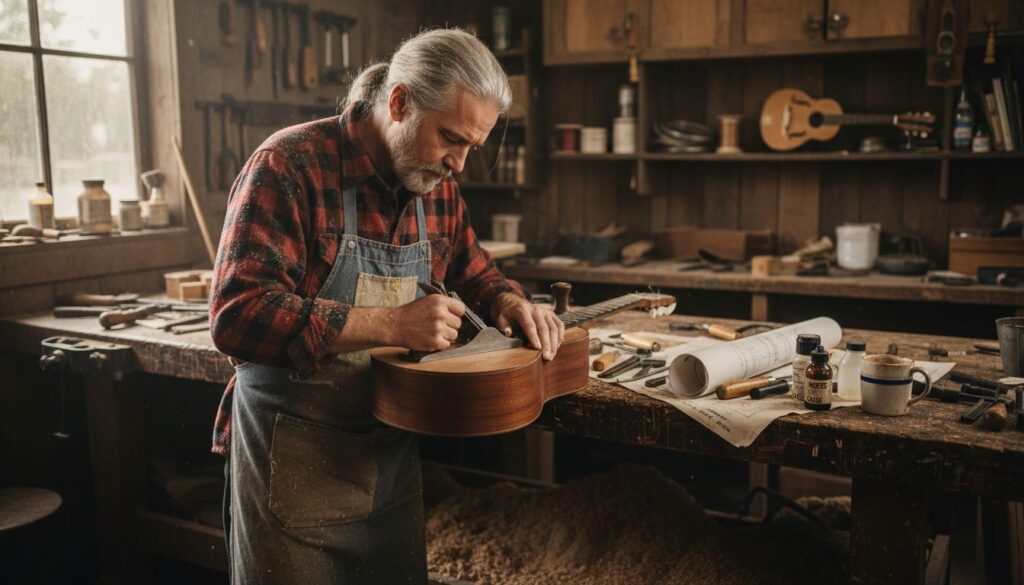

When you think of a guitar’s story, you likely picture legendary musicians on stage. Yet behind every great guitar stands a luthier whose skilled hands transformed raw wood into a resonant instrument. These master craftspeople didn’t just build guitars, they revolutionized acoustic design, pioneered electric innovations, and established standards that define modern instruments. From Renaissance Europe’s lute workshops to today’s custom shops, luthiers shaped guitar evolution through technical mastery and artistic vision. Understanding their contributions reveals why handcrafted guitars remain prized by collectors and musicians who value tone, craftsmanship, and heritage.
Table of Contents
- Origins And Early Role Of Luthiers In Stringed Instrument History
- Antonio De Torres And The Revolution Of Classical Guitar Design
- Key Technical Innovations By Luthiers Shaping Guitar Sound And Structure
- Handcrafted Luthier Guitars Versus Mass-Produced Instruments: Tone, Repair, And Uniqueness
- Explore Vintage And Handmade Guitars With Vintage Guitar World
Key takeaways
| Point | Details |
|---|---|
| Luthiers transform wood | Skilled craftspeople shape tone and design through wood selection and acoustic engineering. |
| Torres revolutionized design | Antonio de Torres established modern classical guitar standards with fan bracing in the 19th century. |
| Innovations changed sound | Resonator cones, solid-body electrics, and lattice bracing expanded guitar capabilities. |
| Handmade offers nuance | Luthier-crafted instruments provide tonal complexity and repairability beyond factory guitars. |
| Techniques influence resonance | Brace voicing and tap-tuning directly control how guitars vibrate and project sound. |
Origins and early role of luthiers in stringed instrument history
Luthiers are skilled craftspeople who build and repair stringed instruments like guitars, originating from Renaissance Europe with roots in lute-making. The term itself derives from the French word for lute, reflecting the craft’s lineage. Before guitars dominated popular music, luthiers honed their techniques on vihuelas, lutes, and early baroque guitars, developing fundamental skills in woodworking, joinery, and acoustic principles that would later transform guitar construction.
During the Renaissance and Baroque periods, luthiers worked primarily on instruments with gut strings and delicate construction. These early makers understood how wood grain, thickness, and bracing patterns affected sound production. They experimented with different body shapes, string lengths, and tuning systems, laying groundwork for modern guitar design. The transition from lute to guitar wasn’t sudden but evolved as musical tastes shifted toward simpler, more accessible instruments.
Early luthiers faced unique challenges without modern tools or scientific acoustic measurements. They relied on intuition, experience, and careful listening to refine their craft. Each instrument was entirely handmade, from carving the neck to shaping the soundboard and installing frets. This artisanal approach meant every guitar possessed distinct tonal characteristics based on the maker’s skill and the wood’s natural properties.
The historical role of luthiers extended beyond simple construction. They served as innovators, problem solvers, and tone architects. Key contributions from this era included:
- Developing gluing techniques that allowed thin, resonant tops to withstand string tension
- Experimenting with body depth and width to enhance bass response
- Refining neck angles and string heights for improved playability
- Creating decorative inlays and rosettes that became signature elements
Before industrialization transformed instrument manufacturing, every guitar represented hundreds of hours of skilled labor. Luthiers selected wood carefully, considering grain patterns, density, and aging. They shaped braces by hand, adjusting thickness and placement to achieve desired tonal balance. This meticulous attention to detail established standards that factory production would later struggle to replicate, creating a lasting divide between handcrafted and mass-produced instruments.
Antonio de Torres and the revolution of classical guitar design
Antonio de Torres revolutionized classical guitar design with fan bracing, larger body, and thinner soundboards, establishing the modern classical guitar standard. Working in Spain from 1817 to 1892, Torres transformed guitars from salon instruments into concert hall performers. His innovations addressed fundamental acoustic limitations that had restricted earlier guitars to intimate settings.
Torres’ most significant contribution was fan bracing, a system of wooden struts radiating from the soundhole in a fan pattern. This bracing provides deep resonance saturated in fundamentals, allowing the top to vibrate more freely while maintaining structural integrity. Before Torres, guitars used simpler ladder bracing that limited volume and tonal complexity. His fan pattern distributed string energy across the entire soundboard, creating richer harmonics and greater projection.
The Spanish master also enlarged the guitar body and reduced soundboard thickness, departures from conservative construction practices. These changes increased air volume inside the body and allowed the top to respond more sensitively to string vibrations. The result was an instrument that could fill concert halls without amplification, fundamentally changing how composers and performers approached the guitar.
“Torres didn’t just build guitars, he reimagined what a guitar could be. His instruments proved that thoughtful engineering could transform a parlor instrument into a serious concert voice.”
| Design Element | Pre-Torres | Torres Standard |
| — | — |
| Body Length | 450-470mm | 490-500mm |
| Soundboard Thickness | 3-4mm | 2-2.5mm |
| Bracing Pattern | Ladder or simple fan | Seven-strut asymmetric fan |
| String Length | 620-640mm | 650mm (modern standard) |
Torres’ influence extended far beyond his own workshop. Notable luthiers influenced by Torres include Manuel Ramirez, Hermann Hauser, and Ignacio Fleta, who studied his instruments and adapted his principles. These makers spread Torres’ innovations throughout Europe and eventually worldwide. Even today, most classical guitars follow his basic template, with modifications rather than wholesale redesigns.
Pro Tip: You can identify Torres-style bracing by gently tapping the soundboard near the bridge and listening for a clear, sustained fundamental tone. Quality fan bracing produces even response across the top with minimal dead spots. Tap different areas and listen for consistent resonance, a hallmark of well-executed fan bracing that Torres pioneered.
Torres worked in two periods, first from 1852 to 1869, then returning to lutherie from 1875 until his death. His second period instruments are particularly prized by collectors for their refined construction and exceptional tone. Many consider his guitars the benchmark against which all classical guitars are measured, a testament to innovations made over 150 years ago.
Key technical innovations by luthiers shaping guitar sound and structure
Beyond Torres’ foundational work, luthiers continued pushing boundaries with innovations that expanded guitar capabilities. John Dopyera’s resonator cones improved guitar volume, addressing musicians’ needs for louder instruments before electric amplification. Working in the 1920s, Dopyera embedded aluminum cones in the guitar body, creating the distinctive metallic tone of resonator guitars still used in blues and bluegrass.
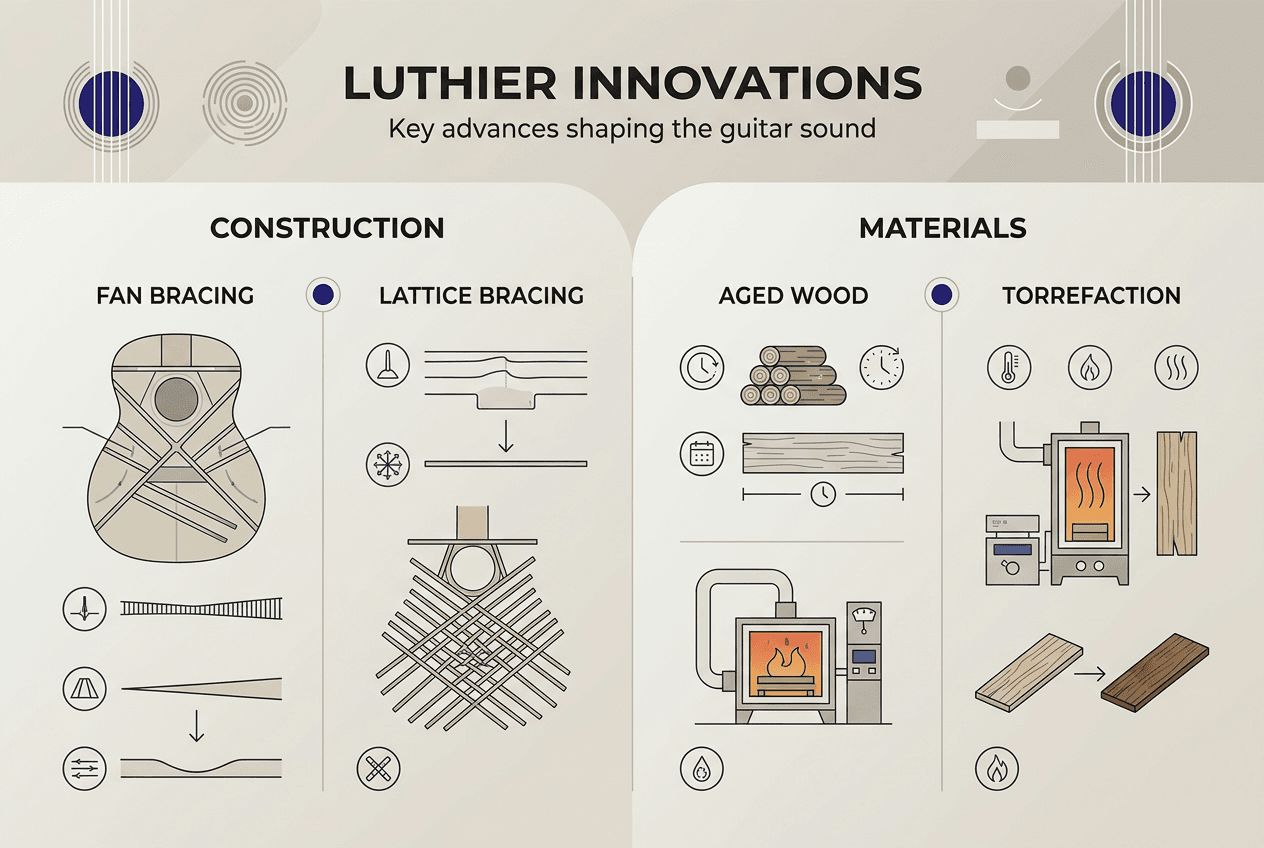
Electric guitar development represented another watershed moment in luthier innovation. Paul Bigsby invented the solid-body electric guitar and vibrato tailpiece, creating tools that defined rock music. His vibrato system allowed players to bend pitch smoothly, adding expressive possibilities impossible on acoustic instruments. Bigsby’s work in the late 1940s preceded and influenced Leo Fender’s mass-produced electric guitars, showing how individual luthiers often pioneer technologies that factories later commercialize.
Modern luthiers continue innovating with materials and construction methods. Greg Smallman introduced thin lattice-braced tops that dramatically increased projection and clarity. His lattice bracing uses a carbon fiber and balsa wood grid that’s stronger and lighter than traditional fan bracing, allowing even thinner tops. Players like John Williams adopted Smallman guitars for their powerful, focused sound, particularly effective in large concert halls.
Bracing patterns control tone by shaping vibration characteristics of the top and body. Different patterns emphasize various frequency ranges and affect how quickly the guitar responds to string attacks. Understanding these patterns helps players and collectors appreciate why guitars with similar woods can sound remarkably different.
| Bracing Type | Tonal Characteristics | Common Applications |
| — | — |
| Fan (Torres) | Warm, balanced, rich fundamentals | Classical, flamenco |
| X-bracing | Bright, strong midrange, punchy | Steel-string acoustic, folk |
| Ladder | Simple, direct, less projection | Early guitars, parlor instruments |
| Lattice | Powerful, clear, fast response | Modern classical concert guitars |
Luthiers also innovate through wood selection and treatment. Some use torrefaction, a heat treatment that ages wood rapidly, creating tonal characteristics of vintage instruments in new guitars. Others experiment with alternative tonewoods as traditional species become scarce, testing materials like walnut, cypress, and even synthetic composites. Each innovation reflects luthiers’ ongoing quest to improve tone, playability, and sustainability.
Pro Tip: Brace shaping, called scalloping or voicing, is where luthiers truly customize tone. By carving braces thinner in specific areas, they control how much each section of the top vibrates. Tap-tuning involves tapping the top and listening to pitch changes as wood is removed, allowing luthiers to target specific resonant frequencies. This hands-on process is impossible to replicate in factory settings and explains why handmade guitars often have more complex, nuanced tone.
Innovative luthier techniques continue evolving as makers combine traditional knowledge with modern materials and analysis. Computer modeling helps predict how design changes affect acoustics, but skilled luthiers still rely on experience and listening to make final adjustments. This blend of science and art defines contemporary lutherie, honoring historical craftsmanship while embracing new possibilities.
Handcrafted luthier guitars versus mass-produced instruments: tone, repair, and uniqueness
Luthiers optimize each guitar’s tone by hand-selecting and shaping wood, unlike mass production which prioritizes consistency and affordability. When a luthier examines a piece of spruce for a soundboard, they consider grain spacing, stiffness, weight, and visual appeal. They adjust their construction approach based on each wood’s characteristics, building the guitar around the material’s strengths rather than forcing wood to fit a predetermined template.
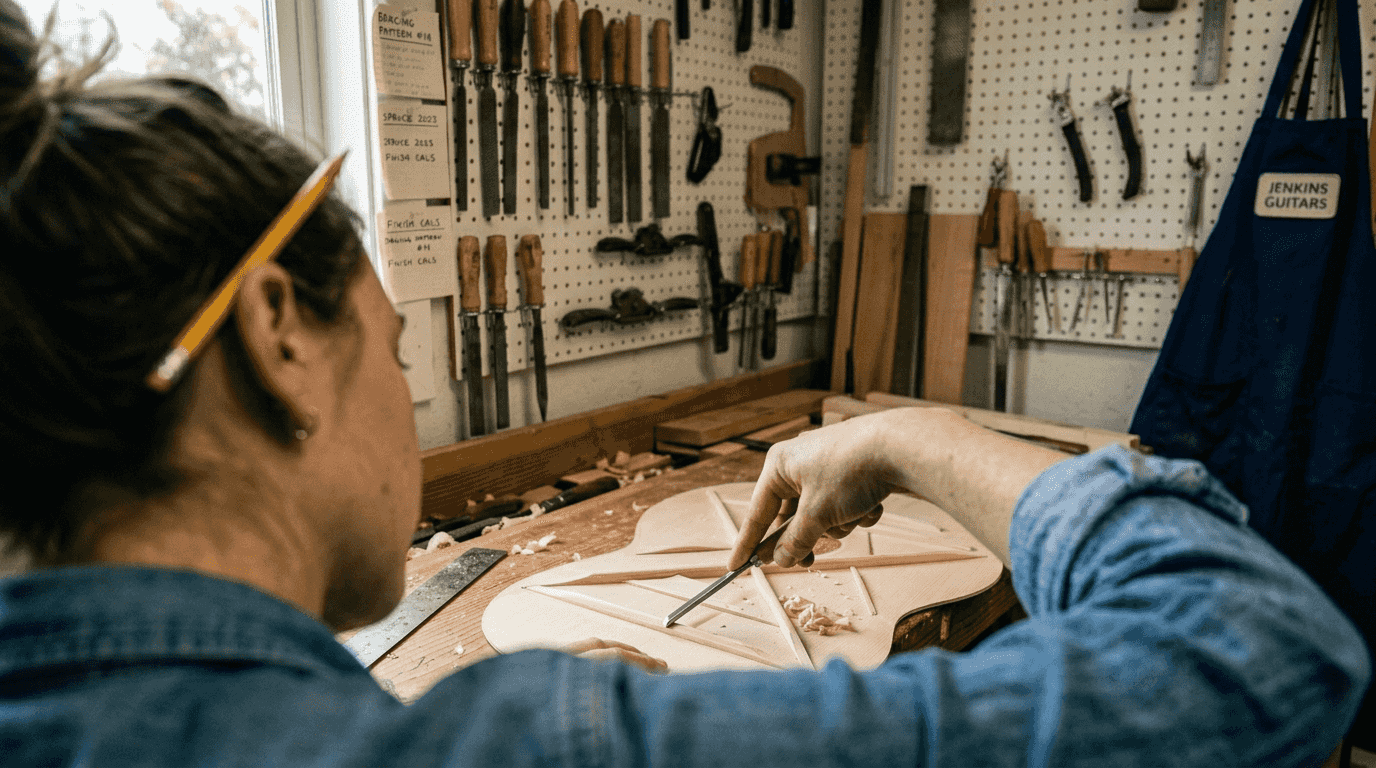
This individualized approach creates instruments with distinct personalities. Two guitars from the same luthier, even using similar woods, will sound different because subtle variations in grain, thickness, and bracing placement affect tone. Luthiers embrace this variability, viewing it as an opportunity to create unique instruments rather than a quality control problem. They hand-voice each brace, adjusting its shape and flexibility to complement the specific top it supports.
Musicians value the soul and nuanced sound of handmade guitars, while factories offer more repair challenges. Master luthier Ervin Somogyi notes that handmade guitars possess a responsiveness and tonal complexity that factory instruments rarely achieve. This difference stems from the attention devoted to each component and the luthier’s ability to make micro-adjustments throughout construction.
Advantages of handmade guitars include:
- Tonal complexity with rich harmonic content and dynamic response across playing styles
- Superior repairability since construction methods are transparent and reversible
- Unique aesthetic details including custom inlays, bindings, and finish work
- Direct communication with the maker for personalized specifications
- Long-term value appreciation as fine handmade instruments become collectible
Mass production differs fundamentally in its manufacturing approach:
- Factories use jigs and templates to ensure identical dimensions across thousands of guitars, prioritizing consistency over individual optimization.
- Computer-controlled machinery cuts components rapidly but cannot adjust for wood variations or make intuitive tonal decisions.
- Assembly line workers specialize in single tasks rather than understanding the complete instrument, limiting their ability to problem-solve or customize.
- Finishes are often thick polyurethane or polyester that’s durable but dampens top vibration compared to thin lacquer or oil finishes luthiers prefer.
- Quality control focuses on meeting minimum standards and avoiding defects rather than maximizing each instrument’s potential.
For collectors, the handmade versus factory guitar distinction affects both immediate playing experience and long-term value. Handmade guitars from respected luthiers typically appreciate over time, especially after the maker’s retirement or death. Factory guitars, even high-quality ones, generally depreciate unless they’re vintage models that have gained historical significance. The craftsmanship, limited production numbers, and documented provenance of luthier-built instruments make them attractive to serious collectors.
Repair considerations also favor handmade instruments. Luthiers use traditional hide glue that can be reversed with heat and moisture, allowing future repairs without damaging wood. They avoid synthetic adhesives and construction shortcuts that complicate restoration. Factory guitars often use permanent glues, pressed-on fretboards, and other techniques that make repairs difficult or impossible. A handmade guitar can potentially be restored and played for centuries, while factory instruments have more limited lifespans.
The playing experience differs too. Handmade guitars often have more immediate response, meaning they speak quickly when strings are plucked and sustain notes with complex harmonic content. They tend to be more forgiving of technique variations while still rewarding skilled playing. Factory guitars can feel more uniform, which some players prefer for consistency, but they rarely offer the same depth of expression that characterizes fine handmade instruments.
Explore vintage and handmade guitars with Vintage Guitar World
Understanding luthier craftsmanship deepens appreciation for the instruments themselves. Whether you’re drawn to the historical significance of vintage guitars or the personalized artistry of contemporary handmade instruments, connecting with quality examples brings this knowledge to life.

Vintage Guitar World specializes in curated collections of rare, restored, and handcrafted guitars that embody the luthier traditions explored in this article. Our inventory includes classical, flamenco, acoustic, and electric guitars from renowned makers, each selected for its craftsmanship, tonal quality, and historical value. We understand why vintage guitars captivate collectors and players, from their aged tonewoods to their connection with guitar-making heritage.
Our platform offers resources to help you make informed decisions:
- Expert guidance on buying vintage guitars covering authentication, condition assessment, and value
- Detailed instructions for finding handmade guitars that match your playing style and preferences
- Testing appointments where you can experience instruments firsthand
- Professional valuation and certification services
Explore our collection to discover instruments crafted by the luthiers who shaped guitar history and contemporary makers continuing their traditions.
Frequently asked questions
What is a luthier and why are they important in guitar making?
A luthier is a skilled craftsperson who builds and repairs stringed instruments, particularly guitars, violins, and lutes. They’re important because they control every aspect of tone production through wood selection, bracing design, and construction techniques. Unlike factory production, luthiers create instruments optimized for acoustic performance and longevity. Their expertise ensures guitars achieve their full sonic potential while remaining repairable for generations.
How did Antonio de Torres influence modern classical guitars?
Torres introduced fan bracing and larger, thinner tops that revolutionized classical guitar construction in the mid-1800s. His innovations allowed better projection and tonal richness, transforming guitars from parlor instruments into concert performers. The 650mm string length and body proportions he established remain standard today. His influence extends through generations of luthiers who studied and adapted his designs, making him the father of modern classical guitar.
What are the differences between handcrafted and mass-produced guitars?
Handcrafted guitars are optimized per wood characteristics and resonate with greater tonal complexity. Luthiers adjust construction based on each piece of wood, hand-voice braces, and use reversible glues for future repairs. Mass-produced guitars provide consistency and affordability but less tonal nuance since they follow fixed templates regardless of wood variations. Handmade instruments typically appreciate in value and offer superior repairability compared to factory guitars.
How do bracing patterns affect guitar tone?
Bracing patterns control how the soundboard vibrates, directly affecting tone color, volume, and sustain. Fan bracing produces warm, balanced tone with rich fundamentals ideal for classical music. X-bracing creates brighter, punchier sound preferred for steel-string acoustics. Lattice bracing offers powerful projection and clarity for concert performance. Luthiers shape and position braces to emphasize specific frequency ranges, making bracing design one of the most important factors in guitar tone.
Why do vintage guitars often sound better than new ones?
Vintage guitars benefit from aged wood that has stabilized and lost moisture over decades, allowing freer vibration. The finish on older instruments is often thinner and has cured completely, reducing dampening effects. Playing also breaks in the guitar, loosening joints slightly and allowing the top to move more freely. Additionally, vintage guitars that survived represent the best examples from their era, since poorly made instruments typically didn’t last. Not all vintage guitars sound superior, but well-maintained examples from skilled luthiers often exhibit exceptional tone that new guitars take years to develop.